


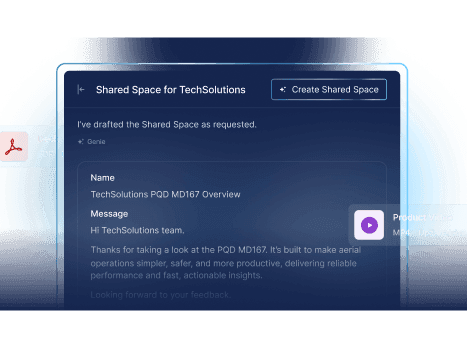







Sales engagement is every interaction a seller has with a buyer, plus the process and tools that make each one relevant, timely, and consistent. For enterprise sellers, it means the right content and the right next step are ready in the room, on a call, or offline.
Picture a rep standing in a plant with no signal, a buying committee waiting, and a pricing question she needs to get right. Whether she finds the approved answer or improvises is sales engagement. And she has less time than you think. Sellers spend just 21% of their day engaging customers (Ebsta and Pavilion). Buyers also do more on their own: 67% prefer a rep-free experience, yet 69% still prefer to validate AI-generated insights with a rep (Gartner). Your sellers know how to sell. Engagement is how you make sure they’re ready for those moments.
Auf einen Blick
- What it is: Every seller-to-buyer interaction, plus the process and tools that make it relevant, timely, and consistent, across email, calls, meetings, shared workspaces, and in-person visits.
- Tool types: Outreach and sequencing, sales enablement and content platforms, digital sales rooms, and conversation and revenue intelligence. Most teams use more than one.
- Who it helps: Enterprise sellers working long cycles and large buying committees, including field teams in low-connectivity settings.
- Where AI fits: AI recommends the next step, drafts outreach, summarizes meetings, and lets sellers practice objections before the real conversation. It earns trust when it answers from content your team has approved.
- What to measure: Buyer response, deal progression, and how often sellers use approved content and AI guidance.
What is sales engagement?
The term covers three things: the interactions with buyers, the process behind them, and the tools that support them. The same interactions are sometimes called buyer engagement, because they look different from the buyer’s side. It happens across email, calls, social messages, meetings, digital sales rooms, and in-person visits.
A sales engagement platform is software that coordinates a seller’s outreach, content, and follow-up across those channels and logs the activity to the CRM. Core functions include multichannel cadences (scheduled sequences of emails, calls, and social messages), CRM logging, and analytics on what drives replies and deals.
For enterprise teams, it also covers the content and next step a seller needs in the room or offline. Buyers use an average of 10 channels per purchase and split their interactions roughly evenly across in-person, remote, and digital (McKinsey), so each touch needs to fit the others.
How does a sales engagement platform work?
A sales engagement platform works in three steps.
Prospecting. Contacts and leads sync from the CRM, and the platform can route each one to the right seller.
Connecting. The seller enrolls each contact in a cadence. It runs until the buyer responds or the sequence ends, and contacts who don’t respond can move to a nurture track.
Managing the relationship. Open rates, call outcomes, and meeting notes show what is working, so sellers can time follow-up and managers can compare activity with results. Enterprise teams also share approved content and digital sales rooms with each stakeholder at this step.
Activity from all three steps logs back to the CRM, so the record stays current without manual entry.
How does sales engagement differ from revenue enablement and buyer engagement?
The three overlap, and teams often use them interchangeably. Sales engagement covers what the seller does with the buyer. Revenue enablement (also called sales enablement) covers what prepares the seller. Buyer engagement covers what the buyer experiences. Sales and buyer engagement describe the same interactions from two sides, so sources often use the terms interchangeably. Sales engagement is the part of revenue execution that happens in front of the buyer.
| Sales engagement | Umsatzgenerierung | Kundenbindung | |
|---|---|---|---|
| Focus | Seller activity and outreach | Seller readiness, content, and coaching | The buyer’s experience across the deal |
| Main question | What does the seller do next? | Does the seller have what they need? | Is the buyer getting value at every step? |
| Typical tools | Outreach sequences, CRM, shared workspaces | Content, training, coaching | Digital sales rooms, mutual plans |
| Where AI helps | Next-best action, outreach drafts, meeting summaries | Practice, coaching feedback, content search | Personalized buyer content, engagement insight |
For more on the enablement side, see What is a sales enablement platform?
Where does sales engagement break for enterprise sellers?
Most engagement advice assumes a seller at a desk with a fast connection. Many enterprise sellers don’t work that way. Five things get in the way.
- Long cycles and large committees. Deals involve many roles, and each one needs a different message.
- Scattered content. Sellers lose time searching, or send something outdated.
- Limited connectivity. Field sellers visit sites, clinics, and plants where signal is unreliable.
- Missing seller feedback. What sellers learn in the field rarely makes it back to the CRM or to marketing. Look for voice, photo, or text capture that syncs to the CRM. See your CRM is only as good as what makes it back from the field.
- Unchecked AI. An assistant that pulls from unapproved sources can put a wrong claim in front of a buyer.
Decision test: Can a seller find, trust, and use the right content in under a minute, in the room or offline? If not, fix that before you add more engagement tools. The same test applies to remote teams: swap “in the room” for “on the call.”
What types of sales engagement tools are there?
Sales engagement tools fall into four groups. Most teams use more than one, and the groups overlap.
| Tool type | What it does | Look for | Am besten geeignet für |
|---|---|---|---|
| Outreach and sequencing | Automates email, call, and social cadences | Multichannel cadences, built-in dialer, email tracking, CRM logging, editable templates | High-volume prospecting |
| Sales enablement and content platforms | Organizes approved content, training, and coaching, and guides sellers to the right asset | Role and stage guidance, permissions, offline access, AI that cites approved sources | Enterprise and field teams with large content libraries |
| Digital sales rooms | Gives buyers one shared space for content, proposals, and next steps | Stakeholder view tracking, easy buyer access, CRM sync | Long cycles and large buying committees |
| Conversation and revenue intelligence | Records and analyzes calls and deals | Summaries that link to the source, deal risk signals | Coaching and forecasting |
How to choose: Match the tool type to where deals stall. If sellers can’t reach enough buyers, start with outreach and sequencing. If they have buyers but can’t find or trust content, start with a content platform. If deals stall across many stakeholders, start with digital sales rooms. If managers can’t see what’s happening in calls, start with conversation intelligence.
Many platforms combine two or more of these.
What should you look for in sales engagement tools?
Six capabilities matter most. Each comes with a decision test you can run in a demo.
1. Multichannel outreach with AI-assisted drafting
Sellers reach buyers by email, phone, and social, and the touches need to stay coordinated. Look for multichannel cadences that queue tasks and follow-ups, a built-in dialer, and email tracking that shows opens, clicks, and replies. AI drafts a first version tailored to the buyer’s role and stage. The seller edits it before it goes out.
Decision test: Can a seller edit an AI draft, and does it pull facts only from approved messaging?
2. CRM connection
Engagement data should flow to and from the CRM, so activity, content use, and outcomes show up where managers already look.
Decision test: Does engagement activity appear on the opportunity record without manual entry?
3. Content guidance
The right content at the right moment is the center of engagement. Look for guidance based on buyer role, deal stage, and region. Recommendations should rank approved content, not the whole library. For the governance side, see sales content governance.
Decision test: When a seller asks for a case study, does the platform surface only current, approved assets?
4. Digital sales rooms
A digital sales room gives buyers one place for the proposal, content, and next steps, and shows sellers what the buyer reviewed. Look for easy buyer access, stakeholder-level view tracking, and activity that syncs to the CRM.
Decision test: Can a seller see which stakeholders opened which content, and follow up with the right person?
5. Engagement analytics and AI summaries
Analytics show what buyers viewed and how deals moved. AI summaries turn meetings and activity into short notes a manager can scan. Treat views as a signal for follow-up, not proof of intent. For measurement methods, see how to measure sales content effectiveness and ROI.
Decision test: Does the summary link back to the source, so a person can verify it?
6. AI that points to approved sources
This capability separates useful AI from risky AI. Look for an assistant that answers from customer-approved knowledge, respects permissions, and shows where each answer came from. A good assistant works from the content, data, and positioning your team has approved, not a general-purpose model that might guess in front of a customer.
Decision test: Ask the assistant a question about pricing or a regulated claim. Does it cite an approved source, or does it guess?
How does AI change sales engagement?
AI helps in four places. In each one, a person stays accountable.
- Next-best action. AI reads deal stage, buyer role, and past activity, then suggests the next content or step.
- Inputs: deal stage, buyer role, past content views, open tasks.
- Example output: “The CFO opened the pricing page twice. Send the ROI case study and propose a call with finance.”
- Where a person decides: the seller chooses whether to send the suggested content.
- Preparation. AI drafts outreach, briefs, and follow-ups. Sellers edit before sending.
- Inputs: approved messaging, the buyer’s role and industry, CRM notes.
- Example output: a first-draft follow-up email that cites only approved claims.
- Where a person decides: the seller edits and approves before sending.
- Summaries. AI condenses meetings and buyer activity so sellers and managers catch up fast.
- Inputs: meeting transcript, notes, buyer activity in the shared workspace.
- Example output: a five-line recap with decisions, open questions, and next steps, linked to the source.
- Where a person decides: the seller or manager confirms the recap against the source.
- Practice and coaching. Sellers rehearse conversations with an AI simulator and get feedback before the real one. The simulator raises realistic buyer objections so reps practice before they’re in front of a customer.
- Inputs: a scenario built from a real deal, such as a pricing objection.
- Example output: a scored rehearsal with feedback on discovery questions and objection handling.
- Where a person decides: the manager or seller decides which skills to work on next.
Example prompts a seller might use:
- “Summarize my last call with this buyer and list open questions.”
- “Which approved case study fits a finance lead in manufacturing?”
- “Draft a follow-up email for the technical evaluator using only approved messaging.”
- “Give me a pricing objection to practice before tomorrow’s meeting.”
Guardrails that keep AI useful:
- Ground answers in approved content.
- Keep a human review step for pricing, legal, and compliance claims.
- Respect who is allowed to see what.
- Track accuracy over time. Sample AI answers each month and check them against the source.
How should you engage each role on the buying committee?
Enterprise deals involve several people, and each one needs a different message. A finance lead wants proof of return. A technical evaluator wants detail. An executive sponsor wants a clear case for change. Map the committee early: who decides, who influences, who can block, and who will use the solution. Then ask each person what a good outcome looks like and tailor the next piece of content to that answer. AI can suggest role-specific content, and the seller chooses what fits. For tactics, read techniques before technology: multithreading in sales.
What are the best practices for sales engagement?
- Lead with the buyer’s outcome. Open with what the buyer wants to achieve, so the conversation connects back to their goal instead of a feature list.
- Match the message to the role. Give each stakeholder content built for their role and their questions, not one generic deck.
- Use async touches. Share a digital sales room so buyers can review on their own time. Committee members who miss the meeting can catch up without a repeat call, and the seller sees who engaged.
- Treat objections as insight. Log them, and let AI group them so marketing sees patterns. An objection that keeps recurring points to a messaging or product gap, not a one-off.
- Prepare offline. Make sure approved content and AI answers work where signal drops. A seller who can’t open the right document on site falls back on memory or an outdated copy.
How do you measure sales engagement?
Track a small set of measures over time.
- Buyer response: replies, meetings booked, and stakeholder participation.
- Deal progression: movement between stages and time in stage.
- Content use: how often sellers use approved assets. Treat it as a leading indicator, not a result.
- AI quality: how often sellers accept AI suggestions, and how accurate sampled answers are.
Compare these signals with win rates and cycle length to see what moves revenue.
How do you put sales engagement into practice?
Strong engagement comes down to what happens before, during, and after each buyer meeting. Use this checklist for any meeting, in person or remote:
- Before the meeting: confirm you can reach the approved content you need, even offline, and choose material by buyer role and deal stage.
- In the meeting: present from approved content, share it with each stakeholder, and note objections as they come up.
- After the meeting: log notes and follow-ups to the CRM the same day, and send a shared space so each stakeholder can review on their own time.
- Field teams: add one step before the visit and confirm offline access to approved content.
Walk into every buyer conversation ready.
See how Showpad helps your sellers find, share, and track approved content with buyers.

Häufig gestellte Fragen
Sales engagement is every interaction a seller has with a buyer, plus the process and tools that make each one relevant, timely, and consistent.
They’re platforms that help sellers reach buyers, share content, track activity, and follow up. They fall into four groups: outreach and sequencing, sales enablement and content platforms, digital sales rooms, and conversation and revenue intelligence. Many platforms combine two or more.
A sales engagement platform is software that coordinates a seller’s outreach, content, and follow-up across email, calls, social messages, and meetings, and logs the activity to the CRM. Core functions include multichannel cadences, CRM logging, and analytics on what drives replies and deals.
A CRM records contacts, deals, and activity. A sales engagement platform helps sellers act on them: finding approved content, preparing for meetings, sharing materials with buyers, and following up. Most teams use both, with engagement data flowing back to the CRM so managers see content use and buyer activity on the opportunity record. If sellers can’t find or trust content, or can’t see what buyers do after a meeting, a CRM alone doesn’t close that gap.
Start with the outcomes the platform is meant to move: win rate, cycle length, and pipeline conversion. Then track the behaviors behind them, such as response rates, how often sellers use approved content, and time spent with buyers instead of searching or logging. Compare results with a baseline from before rollout, and review the same measures over several quarters, since long enterprise cycles take time to show results.
It removes steps between a seller and the next action: coordinated cadences instead of manual follow-up, approved content found in seconds instead of searched for, and activity logged to the CRM automatically instead of by hand. The result is more of the day spent with buyers.
Choose based on where deals stall. If sellers can’t reach enough buyers, start with sales engagement. If they reach buyers but can’t find, trust, or use the right content, start with sales enablement. Many platforms combine both, so check whether one product covers your gaps before you buy two.
Sales engagement covers seller activity with buyers. Revenue enablement covers the content, training, and coaching that prepare sellers for it. Strong teams connect the two.
They overlap, and many teams use the terms interchangeably. Sales engagement describes what the seller does: the outreach, content, and follow-up. Buyer engagement describes the buyer’s experience of those same interactions. Strong teams track both.
AI recommends next steps, drafts outreach, summarizes meetings, and supports practice. Sellers review and approve what reaches buyers.
Limit the assistant to current approved content, and require a cited source on every answer. Route legal, compliance, and other sensitive claims to a person before they reach a buyer. Each month, check a sample of answers against their sources. If a seller can’t click through to the source, the answer isn’t ready to send.
Five practices hold up across enterprise sales engagement. Lead with the buyer’s outcome by opening with what the buyer wants to achieve. Match the message to each role on the buying committee. Use async touches, such as a digital sales room, so buyers can review on their own time. Treat objections as insight by logging them so patterns reach marketing. Prepare for low connectivity by making sure approved content works offline.
Sales teams use them before, during, and after each meeting: role-based material and approved content to prepare, presenting and sharing approved content in the meeting, and same-day CRM logging with a shared follow-up space afterward. Field teams add offline access to approved content before a visit.
Track buyer response, deal progression, content use, and AI quality, and compare them with win rate and cycle length.


