









Safe, trusted AI tools for enterprise sales and marketing are platforms that automate workflows while enforcing data security, governance, and compliance controls.
Revenue teams don’t need more AI demos. They need safe AI and reliable AI—tools that can automate work without leaking data, drifting off-message, or creating compliance risk.
This guide shows you how to evaluate trusted AI tools for marketing and sales, how the stack should fit together, and what to pilot first if you want results your security team can stand behind.
TL;DR
Safe, trusted AI tools for enterprise sales and marketing prioritize data security, governance, and predictable outputs over standalone automation features.
- “Safe AI” focuses on data controls, including encryption, access, retention, and model training policies.
- “Reliable AI” focuses on predictable behavior, including grounding, guardrails, and human review where it matters.
- The safest approach is AI that’s embedded into governed workflows (CRM + enablement), not scattered across browser tabs.
- If you sell complex or regulated products, prioritize platforms built for content governance and approvals.
- The fastest path to value is a 60–90 day governed pilot with clear metrics and a defined risk tier.
Key definitions
Safe AI, reliable AI, and trusted AI are distinct but related concepts in enterprise AI systems.
- Safe AI protects sensitive customer, product, and company data through security controls (encryption, SSO/MFA), data policies (retention and deletion), and governance (access controls).
- Reliable AI predictably by grounding outputs in trusted sources, applying guardrails, and monitoring for errors such as hallucinations.
- Trusted AI tools Trusted AI tools combine safe AI and reliable AI with enterprise governance, including role-based access controls (RBAC), audit trails, approvals, and system integrations.
Common questions about trusted AI tools (quick answers)
What makes an AI tool safe for enterprise sales and marketing?
Safe tools encrypt data, publish security attestations, restrict access by role, and clearly explain retention and model training policies.
How is trusted AI different from “just using ChatGPT”?
Trusted AI is governed and integrated into your systems of record. Consumer tools are easy to adopt—but hard to control.
Do we need AI governance software?
If you’re scaling beyond pilots or operating in regulated markets, yes. Governance turns AI from a risk into a repeatable capability.
How do we prevent hallucinations in customer-facing content?
Ground AI in approved sources, use templates and guardrails, and require human review for high-risk outputs.
Where does a sales enablement platform fit?
Enablement sits between your CRM and customer interactions. It’s where governed content, readiness, and buyer-facing assets should live.
Why trusted AI matters now for revenue teams
Trusted AI matters for enterprise revenue teams because it enables speed without sacrificing control over data, messaging, and compliance.
In sales and marketing, the biggest AI risks aren’t theoretical. They’re practical:
- Sensitive deal data copied into unsanctioned tools.
- Customer-facing emails or proposals that sound confident but are wrong.
- Reps using outdated, unapproved content because the right version is hard to find.
- “Shadow AI” spreading across the org with no visibility, no audit trail, and no consistent policy.
The organizations winning with AI treat governance as a growth enabler. They build an approved path for common workflows so teams don’t feel forced to improvise.
The trusted AI framework for enterprise revenue teams (five pillars)
The trusted AI framework helps enterprise teams evaluate AI tools based on governance, not hype.
If you want safe, reliable AI tools, evaluate every vendor through five pillars. This keeps the conversation grounded in controls—not hype.
1) Data: protect what matters
Safe AI starts with scoping and protecting the data AI can access.
Look for:
- Encryption in transit and at rest
- SSO and MFA
- Data residency and sovereignty options (when needed)
- Clear retention and deletion controls
- Transparent policies on whether your data is used to train shared models
2) Controls: prove who did what (and when)
Reliability requires accountability.
Look for:
- Role-based access controls (RBAC)
- Audit trails and reporting
- Approval workflows for customer-facing outputs
- Admin policies that prevent “anyone can generate anything”
3) Stack: embed AI where governance already exists
Your safest AI tools are the ones that live inside your core stack—especially your CRM and enablement layer.
Why it matters:
- It reduces tool sprawl.
- It keeps content and customer context in one place.
- It makes enforcement possible (identity, permissions, approvals).
This is where platforms designed for governed sales and marketing execution tend to shine—especially those built for complex portfolios and field teams.
4) Behavior: make outputs predictable
Reliable AI is engineered—not wished into existence.
Look for:
- Grounding: AI is constrained to approved sources (not open-ended internet answers)
- Guardrails: templates, prompt standards, and “allowed actions”
- Human-in-the-loop: required review for high-risk outputs
- Monitoring: visibility into what’s generated, shared, and used
5) Outcomes: measure what you care about
Trusted AI earns trust by producing outcomes you can prove.
Choose metrics that match the workflow:
- Time saved per rep per week
- Content findability and usage (especially approved versions)
- Cycle time and win rates
- Forecast accuracy
- Compliance incidents avoided (or reduced)
The AI tool landscape (and where each category fits)
Enterprise revenue teams typically evaluate trusted AI tools across several categories, each serving a different role in the stack.
If you’re searching for “trusted AI tools,” you’re probably evaluating a mix of categories.
Here’s the simple map:
- CRM-native AI: lead scoring, forecasting, pipeline insights
- Sales enablement platforms: governed content, readiness, buyer engagement, AI-assisted search and guidance
- Conversation intelligence: call capture, summaries, coaching signals
- Outbound and engagement tools: sequences, email drafting, automation
- Intent and data providers: enrichment, intent signals, account insights
- AI governance platforms: inventory, policy, risk assessments, approvals, monitoring
- AI security posture management: discovery of AI agents and SaaS AI usage, leakage detection, continuous monitoring
A quick rule: if your business is regulated or your portfolio is complex, your enablement layer becomes your safety layer because it controls what content and guidance make it to the field.
How to evaluate AI vendors for enterprise sales and marketing (governance checklist)
Use this checklist to evaluate whether an AI vendor meets enterprise requirements for security, governance, and reliability.
Security and privacy questions (ask every vendor)
- Which security certifications and reports do you maintain (for example, SOC 2 Type II, ISO 27001)?
- How is customer data encrypted in transit and at rest?
- Do you support SSO, MFA, and SCIM provisioning?
- Where is data stored and processed? Can we select a region?
- What is your data retention policy? Can we configure retention and deletion?
- Is any customer data used to train shared models? If so, what are opt-out options?
Governance and operational control questions
- Can we define RBAC for AI features separately from general app access?
- Do you provide audit logs for AI-generated content and actions?
- Can we require approvals for specific outputs (external emails, proposals, buyer rooms)?
- How do you support policy enforcement (prompt standards, templates, disallowed terms)?
Reliability questions (predictable behavior)
- How do you ground AI outputs in approved sources?
- What guardrails exist to reduce hallucinations?
- What monitoring and reporting do admins get?
Reference architecture: how to build a trusted AI stack for enterprise revenue teams
A trusted AI stack for enterprise sales and marketing typically includes four layers: systems of record, action, control, and visibility.
A trusted AI stack for revenue teams usually looks like this:
- CRM as the system of record (accounts, pipeline, activities)
- Enablement and content governance as the system of action (approved content, learning, buyer-facing workspaces)
- AI governance as the system of control (inventory, risk, policy, approvals, documentation)
- AI security posture management as the system of visibility (monitoring for leakage and unsanctioned AI usage)
- Models and agents constrained to approved data scopes and workflows
In practice, the strongest setups make enablement the front line of governance: it’s where sellers find the right assets, generate drafts grounded in approved content, and share materials in controlled buyer experiences.
If you’re evaluating enablement platforms, prioritize those that are explicit about data security and privacy and that treat governance as a first-class capability—not a bolt-on.
Safe AI use cases across the revenue lifecycle
Use cases are where “trusted AI tools” stop being abstract. Here are practical, governed applications you can deploy without turning your business into a science experiment.
Manufacturing: AI that handles portfolio complexity
Direct answer: In manufacturing, safe AI should help field teams navigate complex product catalogs while keeping specs and pricing aligned to approved sources.
High-value use cases:
- AI-assisted search that returns the right spec sheet by region, product line, and buyer context
- Summaries of long technical docs for faster prep (grounded in approved content)
- Guided configuration or solution recommendations constrained to what you actually sell
- Compliant visit follow-ups that reference only approved claims
Medtech: AI that respects regulated content and sensitive data
Direct answer: In medtech, reliable AI should summarize clinical evidence and approved documentation without introducing new claims or exposing sensitive data.
High-value use cases:
- Summarize instructions for use (IFUs) and clinical evidence from a governed library
- Draft procedure prep checklists that cite approved sources
- Support onboarding and refreshers with role-based access and auditability
- Keep customer-facing content inside approval workflows
Enterprise tech: AI that stays on-message in complex deal cycles
Direct answer: In enterprise tech, safe AI can accelerate proposals and enablement—if outputs are grounded, reviewed, and aligned to pricing and approval policies.
High-value use cases:
- Draft proposals and RFP responses from approved assets
- Auto-generate executive summaries of discovery notes (internal-only)
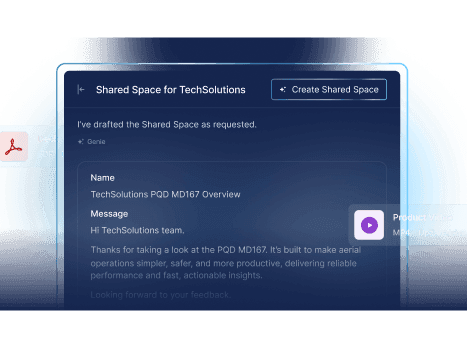
- Create buyer-specific content collections under a controlled sharing experience
How to roll out AI safely: a 60–90 day governed pilot plan
If you want adoption and governance, pilot like you mean it.
- Inventory current AI use (including shadow AI). Identify where reps are already using AI in browsers, plugins, and point tools.
- Classify workflows by risk.
- Low risk: internal summaries, internal search, internal meeting notes
- Medium risk: drafts that require human review
- High risk: customer-facing content sent without review
- Define your guardrails. Document data scopes, allowed sources, approval rules, and disallowed content.
- Choose tools that are embedded into your core stack. Favor AI that lives in your CRM and enablement layer to reduce sprawl and improve control.
- Run a 60–90 day pilot with clear metrics. Track time saved, content usage, cycle time changes, and quality signals.
- Train champions and publish “the approved path.” Make it easy for teams to do the right thing.
- Scale in waves. Add workflows and teams gradually, and keep monitoring outputs and adoption.
Comparison table: tool categories vs trust requirements
| Tool category | Best for | Must-have trust controls | Typical pitfalls |
|---|---|---|---|
| CRM-native AI | Scoring, forecasting, pipeline insights | SSO/MFA, field-level permissions, audit logs | Over-reliance on messy CRM data |
| Sales enablement platform | Governed content, readiness, buyer sharing | Content governance, RBAC, approvals, audit trails | “Content chaos” if governance is weak |
| Conversation intelligence | Call summaries, coaching insights | Retention controls, access by role, redaction options | Capturing sensitive info without policy |
| Outbound / engagement | Sequences, personalization, automation | Approval workflows, templates, logging | Sending unreviewed hallucinations |
| Intent / data tools | Enrichment and prioritization | Compliant data sourcing, access controls | Privacy risk if sourcing is unclear |
| AI governance | Policy, risk, inventory, documentation | Workflow enforcement, monitoring, reporting | Governance that never reaches GTM tools |
| AI security posture management | Discovery and monitoring | Continuous monitoring, leakage detection | False confidence without adoption change |
Key takeaways
Trusted AI for enterprise sales and marketing is not about the most advanced model—it’s about building systems that balance automation with security, governance, and reliability.
If you take one step this week, make it this: pick one governed workflow, pilot it with clear guardrails, and build the approved path your teams will actually follow.
Frequently asked questions
The safest AI tools are enterprise platforms that publish security attestations, limit data retention, support strong identity controls, and integrate with your CRM and governed content systems. Safety improves when AI is embedded into approved workflows—so people don’t default to shadow AI.
Look for vendors that can provide current security reports and certifications (commonly SOC 2 Type II and ISO 27001), along with encryption, SSO/MFA, and documented privacy and retention policies.
Yes, but only when the tools are designed for regulated data, support granular access controls, and clearly document how data is stored, processed, and deleted. In medtech and healthcare-adjacent workflows, keep customer-facing content inside approvals and audit trails.
Ground AI in approved sources, constrain prompts and outputs with guardrails, require human review for medium- and high-risk content, and monitor what’s generated and shared.
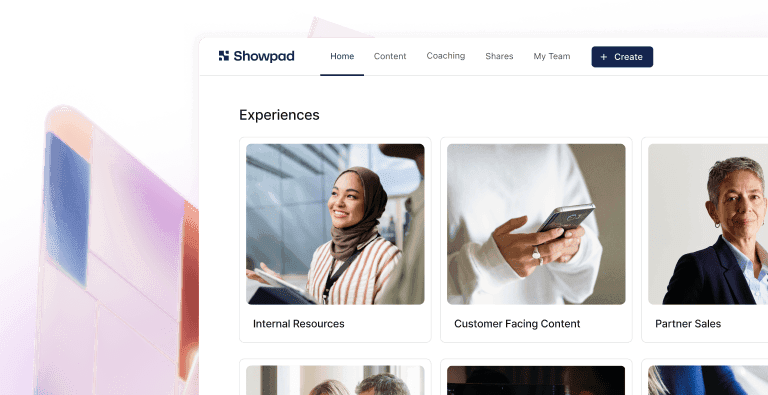
In many enterprise stacks, a platform like Showpad sits between CRM and customer interactions as the governed layer for sales content, readiness, and buyer engagement. That’s where controlled content libraries, permissions, and workflows help AI stay accurate and on-brand.