







The gap between your revenue strategy and what actually happens in the field is wide and costly. According to McKinsey, companies investing in AI-enabled sales and marketing see up to a 15% revenue uplift and a 20% improvement in sales ROI. AI sales enablement is the practice of embedding artificial intelligence into the tools, content, and coaching workflows your sellers use every day, replacing reactive, one-size-fits-all enablement with proactive, personalized, real-time guidance. This guide breaks down the platforms that matter in 2026, compares them head-to-head, and helps you pick the solution that moves your numbers.
Who this guide is for: If you are a VP of sales trying to close the gap between strategy and execution, an enablement leader building scalable coaching programs, or a revenue ops professional evaluating platform ROI, this is your shortlist.
What is AI sales enablement?
AI sales enablement is the integration of artificial intelligence into the systems revenue teams use to prepare, engage, and win. Traditional enablement was passive: upload content to a portal, run a quarterly training, and hope reps find what they need. AI enablement is proactive, surfacing the right content before a meeting, coaching reps in real time, identifying deal risks before they stall, and personalizing onboarding so new hires ramp in weeks instead of months.
In practice, AI sales enablement provides personalized coaching and skill development by analyzing each rep’s strengths and gaps and delivering targeted practice rather than generic training modules. It offers intelligent content delivery so reps do not have to dig through massive libraries. It supplies real-time deal insights to score deal health, flag risks, and suggest next-best actions. It also speeds onboarding through AI-generated training, persona-based role-play, and adaptive learning paths so new hires are productive much faster.
Companies see measurable gaps without these capabilities. Salesforce reports that sales reps spend just 40% of their time actually selling — the rest goes to admin, research, and non-revenue tasks. Salesforce also finds that 46% of reps rarely get feedback on their sales conversations, leaving coaching largely to chance. And according to MIT and InsideSales, conversion rates are 8x higher when leads are engaged within the first five minutes. AI sales enablement addresses these gaps at scale and with speed.
How do the top AI sales enablement platforms compare?
Before diving into each platform, review the capabilities that matter most. Pay attention to offline and field support. If your reps sell in plants, on job sites, or anywhere with unreliable connectivity, offline support separates contenders from pretenders.
| Platform | AI coaching | AI content recommendations | Analytics depth | Offline / field support |
| Showpad | Yes, RolePlayAI persona simulation and Genie Assistant real-time guidance | Yes, context-aware, account-based recommendations | Strong, content usage and platform activity tied to revenue outcomes | Yes, full offline access, mobile-first architecture |
| Highspot | Yes, AI pitch practice with avatars | Yes, predictive content recommendations | Strong, deal impact analytics | Limited offline capability |
| Seismic | Limited, Lessonly-based roleplay (admin-heavy) | Yes, Aura AI engine, content performance insights | Deep, revenue-tied content analytics | Limited offline capability |
| Mindtickle | Yes, certification engine and readiness scoring | Yes, AI-driven content surfacing | Very deep, Readiness Index ties to revenue | Limited offline capability |
| Allego | Yes, video-based peer coaching | Basic content recommendations | Moderate, compliance-focused reporting | Limited offline capability |
| Salesforce Einstein | Limited, CRM-dependent nudges (not standalone coaching) | In-context suggestions only | Deep, but requires Data Cloud and clean CRM data | No native offline support |
| Gong | Yes, AI role-play from real call data | No CMS or content recommendations | Strong, conversation analytics | No offline support |
Top AI sales enablement platforms to watch in 2026
Showpad — AI-powered enablement built for field sales teams
Showpad is built for field selling, with large catalogs, complex specs, tough buyers, and reps who need answers before a plant visit. Its Showpad Genie suite embeds artificial intelligence across the selling workflow, from preparation through follow-up, with a mobile-first architecture and full offline access that few competitors match. It combines content, coaching, buyer engagement, analytics, and field-first AI to keep deals moving in low-connectivity environments.
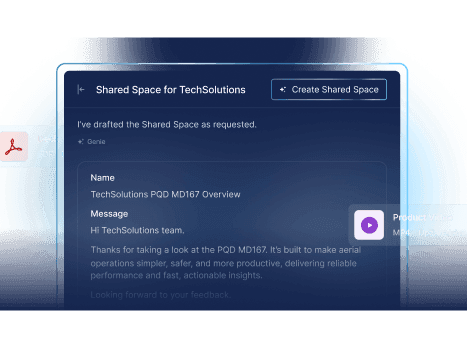
Showpad Genie includes four purpose-built capabilities. Genie Assistant is a live AI chat interface that is an expert co-worker in every seller’s pocket. Before a meeting, it summarizes documents, generates agendas and talking points, and syncs with calendars to compile account history and content recommendations. During a meeting, it provides instant answers and surfaces relevant content based on account context. After a meeting, Field Seller Agent turns recorded speech and photos of handwritten notes into structured CRM-linked summaries, drafts follow-up emails, and identifies action items. RolePlayAI provides AI-powered pitch practice with persona simulation. Admins configure buyer personas based on real account history, so reps practice against realistic buyer interactions and receive instant, unbiased feedback. AuthoringAI auto-generates localized, voice-enabled training at scale by converting slide decks into video and audio content, supporting multiple languages and a voice library for localization.
Strengths:
- Day-one AI readiness, with Showpad Genie capabilities shipping now rather than sitting on a roadmap.
- Clean user experience, unified content and training in one platform, and full offline access for reps selling from trade shows to construction sites.
- High psychological safety for practice, so reps build confidence without peer pressure. A Bigtincan study reports buyers are 13 times more likely to buy from confident sellers.
Trade-offs:
- Lacks the deep certification matrix of platforms like Mindtickle.
- Best suited for field-centric organizations.
Best for: Complex field-selling organizations with physical goods, complex product catalogs, large buying groups, and reps who need AI that works away from a desk.
Recognition: Showpad was recognized as a Customer’s Choice for Revenue Enablement Platforms by Gartner Peer Insights.
Highspot — Enterprise go-to-market productivity and content performance
Highspot is a unified AI-driven enterprise platform for go-to-market productivity and content performance. Its AI capabilities cover content creation, pitch practice, predictive content recommendations, and deal impact analytics. For large enterprise teams with structured sales plays and deep content libraries, Highspot provides a governed system that ties content usage directly to revenue outcomes.
Strengths:
- AI-powered content creation and predictive recommendations tied to deal outcomes.
Strong deal impact analytics connecting content engagement to pipeline movement. - A governance model designed for enterprise-scale content management.
Trade-offs:
- Sales plays can feel rigid, limiting flexibility for teams that adapt quickly in the field.
- Roleplay features rely on robotic avatars, and complex content tagging can create significant implementation drag.
Best for: Large enterprise go-to-market organizations with structured, repeatable sales motions and strong content governance needs.
Seismic — Enterprise content governance with AI, now merged
Seismic has been the enterprise standard for content governance, compliance, and personalization. Its Aura AI engine provides deep content performance insights tied to revenue, making it a strong choice for organizations where compliance and audit trails are required.
In February 2026, Seismic announced intentions to merge with Highspot. For buyers evaluating either platform, this merger introduces uncertainty. Expect an estimated 18-month roadmap freeze as backend systems migrate. Expect overlapping features to consolidate and account teams to change. If you are in a buying cycle, ask detailed questions about integration timelines, feature deprecation, and contract protections.
Strengths:
- Aura AI delivers deep content performance analytics tied to revenue impact.
- Enterprise-grade compliance, governance, and content personalization at scale.
- Broad installed base in large, regulated enterprises.
Trade-offs:
- The merger creates platform uncertainty, roadmap freezes, and potential disruption.
- Roleplay uses acquired Lessonly technology, resulting in a fragmented admin experience and heavy setup burden.
Best for: Large enterprises with strict content compliance requirements that can tolerate merger-related uncertainty for 12–18 months.
Mindtickle — deep readiness analytics and certification
Mindtickle is a revenue enablement platform focused on readiness, coaching, and performance metrics. Its Readiness Index connects individual and team-level readiness scores directly to revenue outcomes, giving sales leaders a data-driven view of which reps are prepared and which need intervention.
For organizations that want sophisticated skill matrices, complex certification programs, and a clear link between coaching and performance data, Mindtickle offers the deepest analytics in the category.
Strengths:
- Readiness Index provides a quantified link between seller preparedness and revenue performance.
- A certification engine that supports complex, multi-level skill development programs.
- Deep data analytics across coaching, content, and performance.
Trade-offs:
- High operational complexity, with significant admin investment required to set up skill matrices and certification workflows.
- Roleplay uses a static image and synthesized voice rather than high-fidelity video avatars, which limits realism.
Best for: Large revenue organizations that prioritize data-driven readiness measurement and require a sophisticated certification infrastructure.
Allego — video-based learning for regulated industries
Allego is known for video-based learning and communication coaching, with particular strength in regulated industries such as financial services and pharmaceuticals. Its interactive video training and peer feedback workflows fit teams where compliance-grade content delivery is required.
The platform lets reps record, share, and receive feedback on practice pitches, creating a peer-learning culture that scales beyond what managers alone can provide.
Strengths:
- Interactive video training with built-in peer feedback loops.
- Compliance-grade content delivery for regulated industries.
- Established workflow for asynchronous video coaching and knowledge sharing.
Trade-offs:
- Legacy video architecture means generative AI features feel bolted on rather than natively integrated.
- Content recommendation and analytics capabilities are less mature than full-suite enablement platforms.
- Best for: Regulated industries where compliance-grade video training and peer coaching are critical.
Salesforce Einstein — CRM-embedded AI for Salesforce-native teams
Salesforce Einstein provides AI analytics, deal health scoring, and in-context nudges inside the CRM. For organizations deeply invested in Salesforce, Einstein offers predictive forecasting and deal intelligence without requiring reps to leave their primary workflow.
The value depends on data quality. If your CRM data is clean and your team works in Salesforce, Einstein surfaces insights where reps already work, but achieving that requires substantial data hygiene and integration work.
Strengths:
- Native AI analytics and deal health scoring embedded in Salesforce.
- Predictive forecasting and in-context nudges that appear in existing CRM workflows.
- Integration with the broader Salesforce ecosystem, including Sales Cloud, Data Cloud, and Slack.
Trade-offs:
- High total cost and complexity, requiring Data Cloud and significant admin and prompt engineering to unlock full value.
- Coaching quality depends on CRM data hygiene. No native connection to broader marketing content or structured sales plays.
Best for: Salesforce-native enterprise teams with clean CRM data and the resources to configure and maintain Einstein.
Gong — conversation intelligence and AI call analysis
Gong leads in conversation intelligence, using AI to analyze sales calls, surface patterns, and identify what top performers do differently. Its newer capability, an AI agent for role-play based on captured sales call data, brings practice into the conversation intelligence workflow.
For teams focused on call quality, identifying winning talk tracks, and coaching based on real buyer interactions, Gong provides deep capabilities.
Strengths:
- AI role-play grounded in real sales call data.
- Deep conversation analytics that identify winning patterns and coaching opportunities.
- Strong adoption among inside sales and SDR teams for call review and feedback.
Trade-offs:
- Narrow point solution, lacking a content management system, so reps cannot tie practice to marketing content or structured sales plays.
- Not designed for field sales workflows, with no offline support and limited meeting prep beyond call analysis.
Best for: Inside sales and SDR teams aiming to improve call performance through conversation intelligence.
Best use cases of AI in sales enablement
Personalized coaching and skill development
Generic training does not stick. Gartner’s finding that nearly 70% of training content is forgotten within a week shows the limits of the old model. AI analyzes each rep’s performance data, identifies specific skill gaps, and delivers targeted practice rather than another slide deck.
Platforms like Showpad’s Roleplay AI let reps practice against AI-generated buyer personas that simulate real objections, temperaments, and buying behaviors. The feedback is instant, objective, and private, which increases usage. The result is faster skill development, higher confidence, and coaching that scales beyond what even your best managers can deliver.
Intelligent content delivery
Marketing teams create hundreds of assets, but reps use only a small fraction. AI content recommendation engines close that gap by surfacing the right content at the right moment, based on deal stage, buyer persona, account history, and what has worked in similar deals.
For example, Forbes reports 74% of buyers choose the rep who first adds value and insight. When sellers enter a meeting with the exact case study or pricing comparison that matches the buyer’s context, content utilization improves, buyer interactions are more relevant, and content usage links more directly to closed deals.
Real-time deal insights
Forecasts fail when deal intelligence relies on gut feel and old pipeline reviews. AI deal insight tools score deal health in real time, flag risks before momentum stalls, and recommend next-best actions based on patterns from thousands of similar deals.
Sales leaders then spend less time chasing updates and more time coaching reps through the deals that matter. Pipeline becomes more predictable, margins hold, and win rates rise.
Faster onboarding
New reps cannot learn thousands of SKUs on day one. Traditional onboarding, like shadowing and classroom training, takes months and delivers inconsistent results. AI-powered onboarding accelerates ramp by generating personalized learning paths, converting existing content into interactive training, and letting new hires practice in realistic scenarios before facing live buyers.
Showpad’s Authoring AI, for example, converts slide decks into voice-enabled, multilingual training content at scale, without requiring a full instructional design team. The result is faster quota attainment, higher confidence, and fewer costly mistakes early on.
How do I choose the right AI sales enablement platform?
Choosing a platform is a strategic decision about how your revenue team will prepare, engage, and win over the next three to five years. Start with these questions:
- Where do your reps actually sell? If your team is in the field, visiting plants, trade shows, or job sites, you need a platform with true offline access and mobile-first design. Most platforms claim mobile support; few work without connectivity.
- What is your coaching model today? If managers spend less than 5% of their time coaching, you need AI that fills that gap rather than a platform that assumes you already have a full coaching program.
- How complex is your content library? Thousands of SKUs, regional variations, and compliance-sensitive materials require intelligent content management, not just a file repository.
- What does your tech stack look like? CRM integration matters, but so does independence. Platforms tightly coupled to a single CRM offer depth in that ecosystem but limit flexibility.
- Can you see the ROI path? McKinsey reports revenue uplift from AI-enabled sales, but that depends on adoption. Prioritize platforms with clean user experience, low admin burden, and fast time to value.
For a deeper framework on evaluating revenue effectiveness across your go-to-market motion, see our Revenue Effectiveness Platforms Guide.
Frequently asked questions
An AI sales enablement platform is software that uses artificial intelligence to help revenue teams prepare for, engage in, and follow up on buyer interactions more effectively. Unlike traditional enablement tools that act as static content repositories, AI-powered platforms proactively recommend content, coach sellers in real time, simulate buyer interactions for practice, and surface deal insights that drive action. The goal is that every rep enters every conversation with the confidence, content, and preparation needed to win.
Focus on five things: AI coaching that truly scales, intelligent content recommendations tied to deal context, analytics that connect enablement activity to revenue outcomes, integration with your existing CRM and tech stack, and support for how your reps actually sell. If your team is in the field, offline access and mobile-first design are requirements.
Start with the numbers. McKinsey reports up to a 15% revenue uplift and a 20% improvement in sales ROI from AI-enabled sales investments. CSO Insights shows a 28% increase in win rates from dynamic coaching programs. Then quantify your current gaps: how long does onboarding take, what percentage of content goes unused, and how much time do reps spend searching for materials instead of selling? Platform costs typically range from $50 to $150 per user per month, with implementation costs between $20,000 and $150,000 according to Altisima Advisory. Map the investment against projected improvements in ramp time, win rate, and content utilization to build a case for your CFO.
Traditional training is event-based, such as a quarterly kickoff or a certification module. AI coaching is continuous, personalized, and scalable. Instead of one manager coaching many reps through every scenario, AI provides a practice partner for each seller. Platforms like Showpad Genie simulate realistic buyer personas so reps can practice objection handling, product positioning, and discovery conversations on their own time, with instant, objective feedback. Practice yields much higher retention than lecture-based training, according to National Training Laboratories.
Vendor consolidation creates real risk for buyers. Expect roadmap freezes while backend systems and product roadmaps are harmonized, possible feature deprecation where overlaps exist, and account team changes. If you are in a buying cycle, ask for written commitments on feature continuity, integration timelines, and contract protections. Consider whether a platform with day-one AI readiness and no merger-related uncertainty offers a more stable path forward.
Showpad is purpose-built for field sales. Its mobile-first architecture with full offline access lets reps prepare for a meeting, access content, and capture follow-up notes from a construction site, a plant floor, or a parking lot with unreliable connectivity. Showpad’s Genie Assistant prepares agendas, recommends content, and converts handwritten notes into structured CRM updates. Few platforms match this level of field-first design.