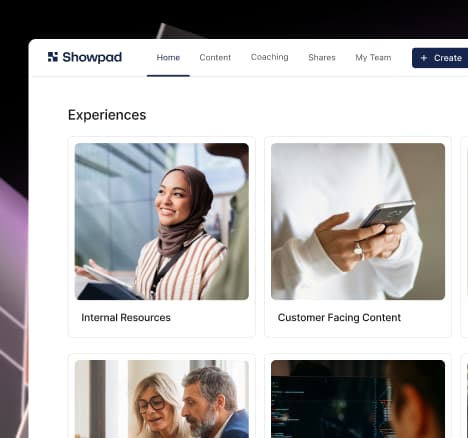


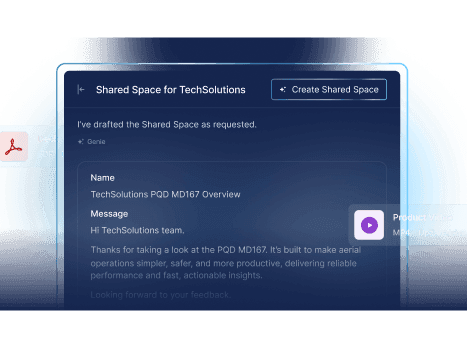








What is a sales content management system?
A sales content management system (sales CMS) is software that helps go-to-market teams centrally organize, govern, distribute, share, and measure customer-facing sales content so sellers can find and use the right approved asset for a specific buyer, situation, or stage of the sales process. Sales organizations waste significant selling time when content is scattered; Salesforce reports sales representatives spend roughly 60% of their time on non-selling work, a large share of which is content search, preparation, and admin.
The five core functions of a sales CMS
- Centralized storage. A controlled source of truth for presentations, videos, product sheets, case studies, battlecards, pricing documents, interactive content, and other approved assets so sellers have one governed library.
- Intelligent organization and discovery. Content is organized by region, product, persona, industry, language, and sales stage, with search and AI recommendations to surface the right asset without folder hunting.
- Version control and content governance. Outdated assets are replaced or retired automatically, and approval workflows, expiration policies, and auditability controls ensure that only accurate, compliant, and current content is available to sellers.
- Role-based permissions. Controls determine who can view, edit, download, present, or share content based on role, region, business unit, or compliance requirements.
- Usage and engagement analytics. Visibility into which assets sellers use, which buyers engage with, where content gaps exist, and, when CRM data is available, which content correlates with pipeline or revenue outcomes.
Sales content management is a core capability within the broader revenue enablement platform category. Showpad, Seismic, Allego, and Dock are purpose-built revenue enablement platforms where content management sits at or near the center of the product. Salesforce and HubSpot are CRM platforms that offer sales content functionality as part of a larger ecosystem. This distinction matters for evaluation: revenue enablement platforms are designed from the ground up to govern, deliver, and measure content across the selling motion, while CRM-native tools treat content as one capability among many. Buyers with serious content governance, field delivery, or analytics requirements will generally find a better fit in a dedicated revenue enablement platform.
How a sales CMS differs from a CRM, CMS, LMS, and file repository
| Category | Primary job |
|---|---|
| Sales CMS | Organize, govern, deliver, share, and measure sales content |
| Revenue enablement platform | Unify sales content management, coaching, readiness, buyer engagement, and analytics across the full selling motion |
| CRM | Manage accounts, contacts, opportunities, and sales activity |
| Web CMS | Create and publish website content |
| LMS | Deliver and track training |
| File repository | Store and collaborate on files |
| Digital sales room | Create a buyer-facing destination for deal content and collaboration |
Many platforms combine several of these categories, but their center of gravity still matters. A CRM that offers document sharing is not the same as a platform purpose-built for governed content delivery to field sellers. Understanding where a platform’s design priorities lie helps buyers avoid misaligned investments.
When does a company need a dedicated sales CMS?
Several signals indicate that shared drives, email, and CRM-native content tools are no longer sufficient:
- Sellers regularly ask marketing for links or the latest version of an asset
- Approved and outdated assets coexist in shared drives with no clear distinction
- Field teams need reliable mobile or offline access to present content
- Marketing cannot see which content is being used, by whom, or how often
- Compliance teams cannot reliably control content availability or distribution
- Buyer-facing experiences feel inconsistent or generic across reps
- Content is disconnected from CRM records and seller workflows
- The company sells across multiple regions, languages, products, or channels
If three or more of these apply, a dedicated sales CMS is likely to deliver measurable operational improvement.
The best sales content management systems at a glance
| Platform | Content types supported | Offline access | AI capabilities | CRM integrations | Compliance features | Pricing tier |
|---|---|---|---|---|---|---|
| Showpad | Documents, presentations, video, interactive content, 3D and AR experiences | Field-oriented mobile and offline content access | Genie search, answer retrieval, and summarization; Authoring AI for creation and editing; governed recommendations | Major CRM integrations including Salesforce, Microsoft Dynamics, HubSpot | Role-based governance, controlled distribution, content lifecycle controls, enterprise security and privacy certifications | Enterprise/custom |
| Seismic | Documents, presentations, dynamic templates, training and enablement content | Mobile support; verify offline scope by application and content type | Aura AI authoring, natural-language search, contextual recommendations, supported summaries | Broad enterprise integration ecosystem including major CRMs | Enterprise permissions, governance, security, and compliance controls | Upper-enterprise/custom |
| Allego | Sales collateral, video, coaching, learning, and conversation content | Mobile access; verify current offline functionality | AI coaching and conversation analysis, contextual recommendations, search, supported summaries | Major CRM and sales-tool integrations | Enterprise permissions and security; verify industry-specific controls | Enterprise/custom |
| Dock | Documents, links, videos, forms, project plans, and workspace content | Primarily online buyer workspaces; verify offline capabilities | AI tagging and descriptions, AI documents, enablement-agent functions | Native Salesforce and HubSpot connections | Workspace access controls, link and branding controls; verify regulated-industry depth | Mid-market to custom |
| Salesforce | CRM records, files, knowledge, enablement, and connected CMS content | Depends on Salesforce mobile product, configuration, and content type | Agentforce/Einstein authoring, retrieval, CRM-context recommendations, record summaries | Native Salesforce ecosystem plus AppExchange | Broad enterprise security, permissions, and compliance framework | Enterprise modular/add-on |
| HubSpot | Documents, playbooks, templates, web, and marketing content | Limited specialist offline sales-content positioning; verify current mobile scope | Breeze authoring, CRM assistance, recommendations, supported summaries | Native HubSpot CRM plus app marketplace | CRM permissions and enterprise controls; less specialized content governance | Entry-to-enterprise by hub |
Methodology: Platforms were evaluated across content accessibility, governance, AI capabilities, CRM integration, field and mobile readiness, compliance depth, and total cost of ownership. This guide assesses fit for specific organizational profiles rather than assigning arbitrary numerical scores.
The market has changed since last year. AI capabilities are now expected in most major platforms, and the completed merger between Seismic and Highspot, finalized on August 18, 2026, has consolidated two major enterprise competitors into one, changing buyer choice at the top of the market. The sections below profile each platform with strengths, trade-offs, AI capabilities, and recommended fit.
How we evaluated the best sales CMS platforms for 2026
Core evaluation criteria
- Content accessibility and discoverability — How easily can sellers find the right asset at the right time?
- Version control and update propagation — How reliably are outdated assets replaced and updates distributed?
- Usage, buyer engagement, and revenue analytics — What visibility do teams get into content performance?
- CRM and workflow integrations — How well does the platform connect to the systems sellers already use?
- Total cost of ownership and implementation fit — What does it actually cost to deploy, adopt, and maintain?
Additional criteria that matter to field and regulated teams
- Offline and mobile access — Can sellers present governed content without a reliable internet connection?
- Supported content formats, including interactive, 3D, and AR content — Does the platform go beyond static PDFs and slide decks?
- Role-based governance, security, and compliance controls — Can content availability be controlled by role, region, language, and regulatory requirement?
- Native AI for authoring, search, recommendations, and summarization — Is AI built into the seller and marketer workflow, or bolted on?
- Seller and administrator usability — Will sellers actually use it, and can admins manage it efficiently?
This guide evaluates fit, not raw feature count. A feature-rich platform can still be the wrong choice if implementation, governance, or seller adoption is weak. The right sales CMS is the one that matches how your organization actually sells.
The best sales content management systems for 2026
Showpad: best field-first sales content management system
Showpad is a revenue effectiveness platform with built-in sales content management, built to put governed, engaging content in sellers’ hands at the point of use. Its combination of offline mobile access, immersive 3D and augmented-reality content, and compliance controls makes it particularly relevant to field sales teams and organizations operating in regulated or content-sensitive industries.
Strengths
- Revenue intelligence that codifies how your best reps win. Showpad doesn’t just track activity — it learns from the behaviors, content, and conversations that close deals, then scales those winning patterns across every seller in the field. The result: your top performers set the standard, and the rest of the team rises to meet it.
- Offline, mobile-first field access. Sellers can access and present approved content in environments where connectivity is limited or unavailable. This is essential for manufacturing, medical devices, life sciences, retail, and any face-to-face sales motion where Wi-Fi is unreliable or nonexistent.
- Immersive 3D and AR content experiences. Field sellers can demonstrate complex or physical products in formats that static documents cannot match, improving buyer understanding for industrial equipment, medical devices, and consumer products.
- Governance and compliance controls. Showpad provides controlled access, approved content distribution, content lifecycle management, role-based permissions, and enterprise security and privacy certifications to reduce operational and regulatory risk.
- Buyer-facing content sharing and digital sales rooms. Showpad enables sellers to share governed content with buyers through trackable links and branded digital experiences, giving marketing visibility into buyer engagement while maintaining content controls.
- Third-party validation. Showpad is the Gartner Peer Insights Customers’ Choice for 2026, with a 4.7 out of 5 rating across 147 reviews, the highest review volume in the sales enablement category.
Trade-offs
- Organizations seeking the broadest possible all-in-one enterprise enablement suite should compare Showpad’s field-first scope with consolidated enterprise suites.
- Advanced immersive content, taxonomy, integrations, and governance still require thoughtful implementation and content operations, and adoption requires meaningful implementation effort.
Showpad AI capabilities
Showpad’s AI layer combines Showpad Genie for natural-language content search, answer retrieval, and summarization at the point of use including on mobile and in field-selling scenarios, Authoring AI for content creation and editing within the governed library, and a Data + Trust Layer that ensures customer data is not used for third-party AI model training.
Best for: Mid-market and enterprise organizations that need governed sales content to work reliably in the field, on mobile, offline, and in regulated or complex product-selling environments.
Pricing tier: Enterprise/custom.
Seismic: best consolidated enterprise enablement suite
Seismic is a revenue enablement platform with built-in sales content management, designed for large, complex organizations that need to unify content management, content automation, learning, coaching, and analytics under a single suite. It is built for revenue organizations with sophisticated governance requirements, broad integration needs, and the operational capacity to deploy and maintain an enterprise-grade enablement program at scale.
Strengths
- Unified content management and enablement suite. Seismic combines governed content management, dynamic document generation, learning, coaching, and analytics in a single platform, reducing the number of point solutions organizations need to manage separately.
- Dynamic content automation. Seismic’s LiveDocs and templating capabilities allow marketing teams to create modular, rules-based templates that sellers can personalize at scale without producing off-brand or non-compliant variations.
- Deep enterprise integration ecosystem. Seismic connects to major CRMs including Salesforce and Microsoft Dynamics, as well as productivity tools, communication platforms, and data systems, making it suited to organizations with complex existing technology stacks.
- Buyer engagement and digital sales rooms. Seismic includes digital sales room capabilities that allow sellers to share governed content with buyers in a trackable, branded destination, connecting buyer engagement data back to seller activity and opportunity context.
Trade-offs
- Enterprise breadth can create greater implementation, administration, migration, and change-management requirements.
- Post-merger product packaging, overlapping capabilities, migration paths, and roadmap priorities may require extra buyer diligence during the integration period.
Seismic AI capabilities
Seismic’s Aura AI powers authoring assistance, natural-language search across governed content, contextual recommendations informed by seller workflow and opportunity data, and AI-generated summaries where supported. Buyers should verify which capabilities are included in standard Aura AI and which require separate products or configurations.
Best for: Very large organizations seeking a broad, consolidated revenue enablement suite and prepared for enterprise-level implementation and governance.
Pricing tier: Upper-enterprise/custom.
What the Seismic–Highspot merger means for sales CMS buyers
The completion of the Seismic–Highspot merger on August 18, 2026 reduces independent enterprise alternatives at the top of the market. Buyers should conduct extra diligence on roadmap priorities, overlapping capabilities, migration paths, contract terms, and pricing before committing to the combined platform.
Questions buyers should ask the combined Seismic organization:
- Which product capabilities will remain, merge, or be retired?
- Will existing Highspot and Seismic customers move to a common platform?
- How will contracts and packaging change?
- Which AI roadmap will become primary?
- What migration support is included?
- How will customer data and content permissions be handled during integration?
- What implementation resources will be required?
Allego: best for coaching-led enablement
Allego is a revenue enablement platform with built-in sales content management whose center of gravity is learning, video-based coaching, conversation intelligence, and reinforcement. It also offers content management and buyer-facing sharing, making it a credible option when content is primarily used to support seller development and in-the-moment guidance.
Strengths
- Centralized sales content library. Allego provides a governed content library where sales collateral, video assets, and enablement materials are organized and distributed to sellers. Content can be surfaced through search and contextual recommendations based on role, stage, or activity, reducing time spent hunting for the right asset.
- Video-based coaching and practice workflows. Allego allows sales managers to assign video-based practice scenarios, review seller responses asynchronously, and provide structured feedback at scale, without requiring live coaching sessions for every rep.
- Conversation intelligence tied to content. Allego connects recorded sales conversations to coaching opportunities and content gaps, helping managers identify which messaging is working in real calls and which skills need reinforcement.
- Integrated readiness and content delivery. Allego combines onboarding, ongoing training, reinforcement, and sales content in a single workflow, so sellers receive assets alongside the coaching context needed to use them effectively. This is a meaningful differentiator for organizations where content and readiness are managed separately today.
- Buyer-facing content sharing and digital sales rooms. Allego allows sellers to share governed content with buyers through branded, trackable digital experiences, connecting buyer engagement signals back to coaching and content effectiveness workflows.
Trade-offs
- Content management may be secondary to coaching and readiness for buyers whose primary requirement is a field-first sales CMS.
- Teams primarily interested in buyer-facing content experiences or immersive field presentations should compare depth carefully against content-first platforms.
Allego AI capabilities
Allego’s AI powers coaching analysis, conversation intelligence, and contextual recommendations informed by role, activity, or conversation context. AI-assisted search across enablement content and conversation summarization support seller preparation.
Best for: Large sales organizations where coaching, conversation analysis, practice, and reinforcement are prioritized over advanced field presentation formats.
Pricing tier: Enterprise/custom.
Dock: best for deal-centric content management and buyer collaboration
Dock is a revenue enablement platform with built-in sales content management that organizes, distributes, and measures content through deal-specific buyer workspaces. Rather than delivering content via email attachments or static links, Dock structures assets into personalized, CRM-connected workspaces for each deal or customer relationship, giving revenue teams visibility into how buyers engage with content at every stage of the sales process.
Strengths
- Deal-centric content delivery. Dock organizes governed sales content into personalized, deal-specific workspaces that consolidate proposals, contracts, case studies, and onboarding materials in a single buyer-facing destination, replacing scattered email threads and untracked file shares.
- Real-time content synchronization. When source assets in Google Drive, OneDrive, or SharePoint are updated, Dock automatically reflects those changes across all active workspaces, reducing the risk of buyers receiving outdated materials mid-deal.
- Buyer engagement analytics connected to CRM. Dock tracks which workspace sections buyers visit, which content they open, and how long they spend on each asset, surfacing deal-risk signals and content effectiveness data directly in CRM records.
Trade-offs
- The platform is more workspace- and deal-room-led than field-presentation-led; organizations that sell face-to-face should assess fit carefully.
- Organizations requiring sophisticated offline access, 3D/AR selling, or highly regulated distribution controls should evaluate feature depth against specialist platforms.
Dock AI capabilities
Dock AI provides automatic tagging and descriptions for content library management, AI document creation and assistance, and enablement-agent recommendations; buyers should verify availability of conversational natural-language library search.
Best for: Startups and mid-market revenue teams that want content management embedded in personalized deal rooms and customer workspaces.
Pricing tier: Mid-market, with entry and custom tiers.
Salesforce: best for CRM-embedded content and workflow automation
Salesforce is primarily a CRM and revenue platform rather than a dedicated sales CMS. Its sales enablement, content, analytics, and Agentforce capabilities can make it a practical option for organizations that want content guidance and automation embedded in Salesforce workflows, particularly when minimizing context switching is a priority.
Strengths
- CRM-native content access. Content, account, opportunity, and activity data operate in the same ecosystem, reducing context switching.
- Workflow automation and extensibility. Strong automation capabilities and AppExchange integrations allow organizations to embed content guidance directly into existing Salesforce processes and workflows.
- Broad enterprise partner ecosystem. Salesforce connects to a wide range of enterprise tools through AppExchange, making it suited to organizations with complex existing technology stacks.
Trade-offs
- Sales content management is one capability within a much larger CRM platform, not the product’s sole design focus.
- Licensing, configuration, data readiness, implementation, and add-on requirements can make total cost difficult to estimate without careful scoping.
Salesforce AI capabilities
Agentforce and Einstein can draft or transform sales communications, retrieve answers from connected enterprise data and knowledge, generate next-best-action and content recommendations from CRM context, and summarize accounts, opportunities, calls, and records. Buyers should clarify which clouds, Data Cloud configuration, or add-ons are required to access specific AI capabilities.
Best for: Organizations deeply standardized on Salesforce that want AI, guidance, and content access embedded in CRM processes and can support platform configuration.
Pricing tier: Enterprise ecosystem with modular/add-on pricing.
HubSpot: best for lightweight sales content management in a CRM ecosystem
HubSpot offers document sharing, playbooks, templates, content tools, AI assistance, and engagement tracking within its CRM ecosystem. It is a practical option for small and mid-market teams that already use HubSpot and want basic sales content capabilities without adding a specialist platform.
Strengths
- Low-friction adoption. Teams already working in HubSpot can access document sharing, playbooks, and templates without adding a new vendor relationship or separate implementation.
- Content and CRM data in one place. Content sharing and engagement data are connected to CRM records and sales activity, giving reps and managers visibility without switching tools.
- Cross-functional platform alignment. HubSpot’s shared platform across marketing, sales, and service reduces handoff friction and keeps content, contacts, and conversations in a single system.
Trade-offs
- Content management is a supporting CRM capability rather than a specialist enterprise sales CMS.
- Advanced governance, offline field access, immersive 3D/AR content, and complex content operations may require a dedicated platform.
HubSpot AI capabilities
Breeze and Content Hub support AI-assisted content creation and repurposing, CRM and knowledge retrieval, workflow-based recommendations, and record and conversation summarization; verify depth and search across governed sales collateral versus general CRM data.
Best for: Small and mid-market teams already using HubSpot that need practical document sharing, playbooks, and engagement tracking more than a specialized enterprise content-governance layer.
Pricing tier: Entry-to-enterprise, with feature gates by hub and edition.
How to choose a sales content management system
Start with the selling environment, not the feature list
Before comparing features, answer these questions about how your organization actually sells:
- Are sellers primarily remote, inside sales, hybrid, or field-based?
- Must content work offline or in low-connectivity environments?
- Do sellers demonstrate physical or technically complex products?
- Would 3D or AR content improve buyer understanding?
- Does the company operate in a regulated industry with content compliance requirements?
- Is the primary requirement content delivery, coaching, CRM consolidation, or buyer workspaces?
The answers should eliminate categories of platforms before detailed evaluation begins. A coaching-led platform is the wrong investment if your primary need is governed field content delivery, and vice versa.
Evaluate content governance
Content governance separates a sales CMS from a file-sharing tool. Assess each platform across:
- Approval workflows for new and updated content
- Version control and automatic retirement of outdated assets
- Expiration and archiving policies
- Role-, region-, product-, and language-based permissions
- Download and external-sharing controls
- Auditability and compliance reporting
- Update propagation across all seller access points
- Clear content ownership between marketing, sales, and compliance
Test AI against four practical jobs
Use a consistent framework to evaluate AI across every platform:
- Authoring: Can AI create, edit, adapt, localize, or repurpose content within the governed workflow?
- Search: Can a seller ask a natural-language question and retrieve an approved answer or asset?
- Recommendations: Does AI surface useful content based on role, buyer, opportunity, or deal stage?
- Summarization: Can AI explain the key points of an asset without requiring the seller to open and read it in full?
Beyond these four jobs, ask additional questions:
- Is the AI grounded only in approved content, or can it hallucinate from external data?
- Does it respect role-based permissions?
- Are source citations shown to the seller?
- How is customer data used, and is it used for third-party model training?
- Is the capability included in the base platform or an add-on?
- Does it work on mobile and at the point of use, or only in a desktop browser?
Calculate total cost of ownership
List price is misleading. A complete TCO calculation should include:
- Platform license fees
- Required modules and AI add-ons
- Implementation services
- Content audit and migration
- Metadata and taxonomy design
- CRM integration
- Security review
- Administrator time (ongoing)
- Training and change management
- Ongoing content governance operations
- Renewal and expansion costs
Compare three-year TCO rather than annual list price. A platform with a lower seat cost but higher implementation, integration, and administration burden may cost more over time.
Run a representative seller test
Require every vendor on your shortlist to demonstrate these scenarios with your content and your workflows:
- A rep finding an approved asset from a natural-language query
- A marketer replacing an outdated version and confirming propagation
- A compliance manager restricting content by region or role
- A field seller accessing and presenting content offline on a mobile device
- A seller using immersive or interactive content in a buyer conversation
- A buyer receiving and engaging with shared content
- An admin tracing usage and engagement back to CRM context
If a vendor cannot demonstrate a scenario that matters to your organization, that is a meaningful signal, regardless of what the feature list says.
Which sales CMS is best for your organization?
The best sales CMS depends on where and how sellers work. Seismic is suited to organizations seeking a consolidated enterprise suite; Allego leads with coaching; Dock leads with buyer workspaces; and Salesforce or HubSpot can suit CRM-led teams. Showpad is the strongest independent, field-first option for organizations that need approved content to remain accessible, engaging, and controlled across mobile, offline, immersive, and regulated selling environments.
Explore Showpad's sales content management platform
See how Showpad puts governed, up-to-date content in sellers' hands at the point of use, on mobile, offline, and in the field.

Frequently asked questions
Pricing for sales content management systems varies widely by platform tier, deployment scope, and required modules. Entry-level tools and CRM-native options such as HubSpot start at a few hundred dollars per user per year, while mid-market platforms like Dock offer tiered pricing with custom enterprise options. Dedicated enterprise platforms such as Showpad, Seismic, and Allego use custom quote-based pricing that depends on user count, integrations, AI entitlements, implementation services, and support tier. Total cost of ownership should include implementation, content migration, taxonomy design, CRM integration, ongoing administration, and change management, which can add significantly to the base license cost. Comparing three-year TCO rather than annual list price gives a more accurate picture of relative investment.
The leading dedicated sales content management platforms in 2026 are Showpad, Seismic (which completed its merger with Highspot in August 2026), and Allego, each targeting enterprise organizations with different centers of gravity around field selling, suite consolidation, and coaching respectively. Dock is a strong option for teams prioritizing buyer-facing digital sales rooms alongside content management. Salesforce and HubSpot offer sales content capabilities embedded in their CRM ecosystems, making them practical for organizations already standardized on those platforms. The right platform depends on how and where sellers work, what governance and compliance requirements apply, and how content connects to CRM data and revenue outcomes.
The most significant trend in 2026 is the shift from keyword search to natural-language and answer-based content discovery, with AI enabling sellers to ask questions and receive governed answers rather than browsing folders. AI-assisted authoring, summarization, and content recommendations are now standard expectations across enterprise platforms rather than differentiators. Market consolidation accelerated with the Seismic-Highspot merger in August 2026, reducing independent alternatives at the enterprise tier. Immersive content formats including interactive, 3D, and augmented-reality experiences are gaining traction in industries where physical or complex products are sold face to face. Automated content governance, including version control, expiration policies, and compliance controls, has become a core evaluation criterion as organizations face greater regulatory and messaging risk.
Start by mapping your selling environment: whether sellers are field-based, remote, or inside sales determines which platform capabilities matter most, including offline access, mobile readiness, and content presentation format. Evaluate governance depth carefully, including approval workflows, version control, role-based permissions, expiration policies, and auditability, since this is what separates a dedicated sales CMS from a file repository. Test AI capabilities against four practical jobs: authoring, natural-language search, contextual recommendations, and summarization, and ask whether AI is grounded in approved content or can hallucinate from external sources. Calculate three-year total cost of ownership including implementation, migration, integrations, and ongoing administration rather than comparing list prices. Require vendors to demonstrate their platform with your actual content and workflows before shortlisting.
The merger, finalized on August 18, 2026, consolidates two of the most frequently shortlisted enterprise sales enablement platforms into a single combined organization operating under the Seismic name. For buyers, this reduces independent alternatives at the top of the enterprise market and makes roadmap, packaging, and migration diligence more important than usual during an evaluation. Existing Highspot customers should clarify product support timelines, contract migration terms, and feature parity before their next renewal. Buyers new to the market should ask the combined organization how overlapping capabilities across content management, AI, coaching, and analytics will be rationalized, and which roadmap takes priority. The consolidation strengthens the case for evaluating independent alternatives such as Showpad, Allego, and Dock alongside the combined suite.