









Revenue effectiveness is the discipline of aligning content, seller readiness, buyer engagement, and revenue execution so that successful selling actions become repeatable and produce predictable outcomes, rather than one-off wins. It matters most for field-centric selling organizations running complex, multi-stakeholder deals across distributed teams.
En bref
- Revenue effectiveness rests on four pillars: content, readiness, buyer engagement, and revenue execution.
- Four key outcome metrics show whether it’s working: win rate, ramp time, pipeline conversion rate, and quota attainment.
- Field selling needs its own approach: offline access, large product catalogs with complex details, compliance, and long buying committees.
- The revenue effectiveness gap, the distance between revenue strategy and field execution, has four drivers: skills, execution, expectations, and transformation.
Generic usage and adoption thinking won’t get field-selling teams to predictable performance. Revenue effectiveness gives you a framework and a platform architecture to close that gap. Revenue effectiveness is the outcome. Revenue execution is how strategy reaches the buyer. This article defines the term, introduces the four-pillar framework that underpins Showpad’s platform, and shows how to measure what matters.
Showpad defined the AI-native revenue effectiveness category, with the launch of the first end-to-end platform for field sales organizations. For a deeper dive into platform evaluation and buying criteria, see our revenue effectiveness platform guide.
Where does field sales lose time and revenue?
According to Forrester research, sellers waste about 14 of 51 working hours a week on administrative tasks such as navigating fragmented systems and manually managing information. Legacy sales enablement and revenue technologies remain fragmented, and generic AI tools fail to capture the realities of field selling.
- Showpad Genie grounds every AI action in your approved content, real customer interactions, and proven sales behaviors through the Effectiveness Data + Trust Layer, and powers Genie Assistant, Roleplay AI, and Field Seller Agent.
- Built for field-selling organizations in manufacturing, consumer packaged goods, and medical devices, with more than 2,000 customers.
- Sellers using Showpad have seen median quota achievement up to 44% higher.
"Field sales have long lacked true revenue effectiveness, with too much value lost between strategy and execution. Showpad's approach demonstrates leadership in bringing AI, data, and execution together to address that gap."
Jim Lundy
Fondateur, PDG et analyste en chef chez Aragon Research

What is the revenue effectiveness gap?
The revenue effectiveness gap is the widening distance between revenue strategy and field execution. It comes from four gaps.
| Gap | Status quo | With revenue effectiveness | Evidence |
|---|---|---|---|
| Skills | Overwhelmed sellers | Productive sellers | 72% of sellers are less productive because they’re overwhelmed by the number of skills and tools (Gartner Seller Skills Survey) |
| Execution | Operational chaos | Operational excellence | Up to 30% of revenue potential is lost to inconsistent execution across the revenue team (Showpad) |
| Expectations | Losing deals to unmet buyer-committee needs | Meeting buyer-committee demands | More than 40% of B2B deals stall when buying groups can’t align internally (Edelman B2B Thought Leadership Report) |
| Transformation | Using AI for time savings | Using AI for decision-making | About 80% of organizations set efficiency as an AI objective (McKinsey, The State of AI) |
These gaps compound. Overwhelmed sellers execute inconsistently, inconsistent execution loses buying committees, and AI used only to save time fixes neither. Adding another point solution doesn’t close them. Content and learning systems solve one slice, separate sales tools add silos, and CRM and revenue intelligence show what happened without changing what happens in the room.
Revenue effectiveness replaces that patchwork with one connected system. Teams move from inconsistent buyer experiences to seller-led collaboration, and from generic training to continuous guidance. Showpad delivers it through four pillars: content, readiness, buyer engagement, and revenue execution, the daily delivery of strategy through seller work before, during, and after every buyer meeting. This article walks through each pillar first, then defines the terms around revenue effectiveness.
The four pillars of revenue effectiveness
Revenue effectiveness rests on four pillars: content, readiness, buyer engagement, and revenue execution. Each pillar ties to a measurable outcome.
The pillars run on the four-layer architecture Showpad uses: workspace, Showpad Genie, trust and governance, and data.
1. Content
Governed, buyer-ready content mapped to every stage of the sales process. Instead of a content library sellers have to dig through, this pillar ensures the right asset reaches the right buyer at the right moment.
Measurable outcome: higher content-to-close correlation: you can trace which assets actually influence closed deals, not just which ones buyers open.
2. Readiness
Seller training, onboarding, preparation, coaching, and practice before the call, not after a lost deal. Readiness means new hires ramp faster and experienced reps stay sharp on new products, messaging, and competitive positioning.
Measurable outcome: shorter ramp time for new sellers, measured in weeks-to-first-deal rather than months-in-seat.
3. Buyer engagement
Structured, trackable interactions across every member of the buying committee. In complex deals, the seller who engages only one champion loses to the team that reaches the economic buyer, the technical evaluator, and the end user.
Measurable outcome: higher win rate on multi-stakeholder deals, driven by broader and deeper engagement across the buying committee.
4. Revenue execution
Strategy carried into every buyer meeting: preparation before, support during, and follow-through after. This pillar is where the other three show up in the seller’s day, so results don’t depend on which seller has the deal. For a closer look at how execution works day to day, see What is revenue execution?
Measurable outcome: consistent execution across sellers and territories, shown by preparation, buyer engagement, and follow-up completed on every deal, with the CRM reflecting what happened in the room.
How revenue effectiveness differs from enablement, execution, and orchestration
Revenue effectiveness, enablement, execution, and orchestration get used interchangeably in analyst reports, vendor pitches, and boardroom conversations, but they aren’t the same thing. Each term represents a different scope, a different measurement philosophy, and a different definition of success.
| Term | Scope | What it measures | What success looks like |
|---|---|---|---|
| Aide à la vente | Content, training, and engagement infrastructure for sellers. | Activity metrics such as content downloads, course completions, and portal logins. | Sellers have the resources and preparation they need to enter every conversation ready. |
| Activation des revenus | Enablement extended across the full customer lifecycle — marketing, sales, CS, and partners. | Cross-functional alignment and consistency of go-to-market execution. | Every customer-facing team operates from the same playbook with consistent messaging. |
| Revenue execution | Daily delivery of revenue strategy through seller work: content, preparation, conversations, and follow-through. | Consistency of the work before, during, and after buyer meetings, such as preparation, buyer engagement, and follow-up. | Strategy reaches the buyer the same way on every deal and with every seller. |
| Revenue orchestration | Coordination of the people, process, data, and technology behind a deal, typically owned by revenue operations. | How well teams, data, and systems stay aligned to revenue goals. | The right person acts at the right time, with the data they need. |
| Efficacité des recettes | Strategic alignment of content, readiness, engagement, and execution to revenue outcomes. | Win rate, ramp time, pipeline conversion rate, and forecast accuracy. | The organization produces predictable, repeatable revenue performance, rather than isolated heroics. |
The critical distinction:
- Sales enablement asks whether sellers have what they need.
- Revenue enablement asks whether teams are aligned with the customer journey.
- Revenue effectiveness asks whether the organization is winning predictably, and whether you can prove why.
- Revenue execution asks whether the right things happen before, during, and after every buyer meeting or other customer engagement.
- Revenue orchestration asks whether the teams, data, and systems behind a deal are aligned to operate smoothly.
Revenue execution is a foundation for revenue effectiveness. When delivery is inconsistent, results hinge on individual sellers and don’t repeat across the team. Effectiveness is the proof that the work is producing the right results for the right buyers. Revenue orchestration, usually owned by revenue operations, coordinates the work behind each deal, and Showpad contributes buyer engagement signals from Shared Spaces and meeting capture from Field Seller Agent.
How do you measure revenue effectiveness?
Measure revenue effectiveness through four outcome metrics: win rate, ramp time, pipeline conversion rate, and forecast accuracy. The market already draws a useful line between sales effectiveness and sales efficiency. Efficiency asks how much output per unit of input. Effectiveness asks whether you’re producing the right outcomes. Revenue effectiveness focuses that second question for field-selling organizations.
Outcome metrics that matter
- Win rate — The percentage of qualified opportunities that close. This is the clearest signal of whether your content, readiness, engagement, and execution are working together.
- Ramp time — How quickly a new seller reaches full productivity, measured by time-to-first-deal or time-to-quota.
- Pipeline conversion rate — The percentage of pipeline that advances from stage to stage and ultimately converts to revenue.
- Forecast accuracy — The gap between what you predicted and what you closed, measured over rolling quarters.
Behavior metrics that explain the outcomes
Behavior metrics sit between outcomes and activity. They show what drives results and where revenue execution breaks down: which content shows up in won deals versus lost ones, whether sellers prepared before meetings (briefings accessed, roleplay sessions completed), how many stakeholders engage with shared content, and how quickly sellers follow up afterward.
What these are not
Activity metrics — content downloads, login frequency, course completions, email opens — tell you whether sellers are using the platform. They don’t tell you whether the platform is producing revenue. Activity metrics are inputs. Outcome metrics are the scoreboard.
Why does field selling need its own approach?
Most sales-effectiveness frameworks assume desk-based, CRM-centric selling teams: always online, always in the CRM, always selling to a single decision-maker. That assumption breaks down quickly in field selling.
Consider the reality of a medical-device rep walking into a hospital, a building-materials seller visiting a distributor warehouse, or a specialty-chemicals team presenting to a plant manager on a factory floor. Field sellers face conditions that generic frameworks don’t account for:
- Offline execution. Connectivity is unreliable in manufacturing plants, hospitals, and remote job sites. If your platform doesn’t work offline, your sellers are on their own.
- Multi-stakeholder buying committees. Sellers get just 5% of the buyer’s journey to prove their expertise (Gartner), and 68% of deals stall from stakeholder misalignment (Prospeo). Field sellers need to engage buying committees that span procurement, operations, technical evaluation, and executive sponsorship, often across multiple site visits.
- High-SKU portfolio complexity. A seller representing hundreds or thousands of SKUs can’t memorize every spec sheet. They need governed, searchable content that surfaces the right product information in context.
- Compliance and regulatory requirements. In industries like life sciences, manufacturing, and consumer packaged goods, sharing the wrong version of a document is more than embarrassing: it’s a compliance violation.
Generic “improve your win rate” advice doesn’t address these realities. Revenue effectiveness, as a discipline, meets these demands head-on.
Analyst research supports the field-selling focus. Forrester Wave REP 2024: “Best for medium to large enterprises in CPG, healthcare, and manufacturing in which customer presentation requires immersive, graphical content experiences.” Gartner Magic Quadrant 2025: “Proven scalability across thousands of users, mobile-first architecture, and advanced compliance infrastructure.”
How do you improve revenue effectiveness?
Improve revenue effectiveness by closing the gap between strategy and seller action, then measuring whether it closed. Start with four moves.
Define outcomes before activities. Pick the results you want to move, such as win rate, ramp time, and pipeline conversion, then map the buyer meetings where execution quality matters most, like the first evaluation meeting or the procurement review.
Govern what sellers share. Give every asset an owner and an expiration date, and set permissions so sellers see only what’s approved for their market and product line.
Prepare sellers for the specific meeting. Pair practice and content recommendations with the next buyer conversation, not a generic curriculum.
Capture what happens with buyers and connect it to results. Feed meeting outcomes and buyer engagement into the CRM, then tie them to win rate and cycle length so managers coach to the behaviors that win.
How does the Showpad platform provide revenue effectiveness?
Showpad’s platform puts the four pillars to work through four commitments built for field-selling organizations.
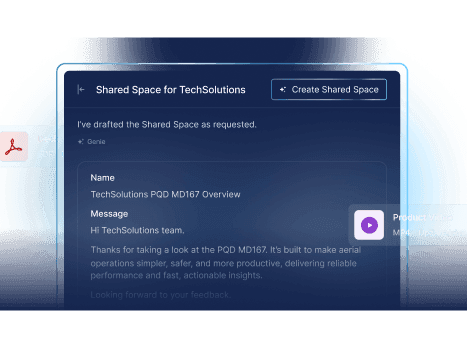
Revenue execution across every meeting. Showpad’s revenue execution capabilities carry strategy into every buyer meeting. Before the meeting, Field Seller Agent turns CRM data, meeting transcripts, and field notes into a Meeting Prep briefing, and Roleplay AI lets sellers rehearse the conversation. During it, Genie answers questions about accounts and opportunities in plain language and shows only what each seller is permitted to see. Afterward, sellers speak their update and, once they confirm it, Field Seller Agent writes it to the CRM, even offline on iOS. Between meetings, Shared Spaces show which buyer stakeholders are engaged and which have gone quiet.
Governed AI with Showpad Genie. Genie generates recommendations, summaries, and next-best actions grounded in your organization’s approved knowledge, not the open internet. That means sellers get answers, summaries, and next steps that stay accurate, compliant, and aligned to your messaging. Governance is the foundation.
Offline-first field execution. Sellers can access content, deliver presentations, and capture buyer engagement data without a network connection. When connectivity returns, everything syncs. This isn’t a workaround. It’s how the platform works, because field selling demands it.
Portfolio complexity management. For organizations with large, technical product catalogs, Showpad maps content to products, personas, and sales stages so sellers find what they need in seconds rather than minutes. Showpad also integrates with common CRM and analytics platforms to tie field activity to deal outcomes. Explore how this works on the platform overview, and see how activity connects to outcomes on the analytics and revenue intelligence page.
The result: your best sellers’ actions become the playbook, and the playbook becomes repeatable across every rep, every region, and every channel.
"Showpad is defining a new standard for revenue effectiveness — where AI is not just generating insights, but actively driving execution."

Apratim Purakayastha
CEO of Showpad
Foire aux questions
Showpad defined the AI-native revenue effectiveness category, with the launch of the first end-to-end AI-native platform that unifies content management, sales readiness, buyer engagement, and revenue intelligence for field sales organizations. Showpad’s CEO, Apratim Purakayastha, described the launch as defining a new standard for revenue effectiveness.
Revenue effectiveness is the discipline of aligning content, seller readiness, buyer engagement, and revenue execution so that successful selling actions become repeatable and produce predictable outcomes. Revenue effectiveness goes beyond generic sales metrics by focusing on the operational practices that drive win rates, shorten ramp time, and improve forecast accuracy, especially for field-selling teams running complex deals.
The revenue effectiveness gap is the widening distance between revenue strategy and field execution. Four gaps drive it: skills, execution, expectations, and transformation. Revenue effectiveness closes the gap by aligning content, readiness, buyer engagement, and revenue execution around outcomes the business can measure.
A revenue effectiveness platform is a solution that puts the four pillars to work — content, readiness, buyer engagement, and revenue execution — within a single architecture. A revenue effectiveness platform connects what sellers do in the field to measurable revenue outcomes, rather than simply housing content or tracking activity. Showpad’s platform, for example, combines governed AI, offline execution, and portfolio complexity management to provide this for distributed field teams and channel partners.
Sales enablement focuses on giving sellers the content, training, and engagement infrastructure they need to be prepared. Revenue effectiveness builds on that foundation by measuring whether those inputs actually produce revenue outcomes — win rate improvement, faster ramp, higher pipeline conversion, and more accurate forecasts. Enablement is a necessary condition. Effectiveness is the result.
Revenue enablement extends the enablement discipline across the full customer lifecycle and all customer-facing teams, measuring cross-functional alignment. Revenue effectiveness narrows the focus to outcome measurement: are the aligned teams producing predictable, repeatable revenue? The distinction is between coordination (enablement) and performance (effectiveness).
The four primary outcome metrics are win rate, ramp time, pipeline conversion rate, and forecast accuracy. Outcome metrics are distinct from activity metrics like content downloads, course completions, or login frequency. Activity metrics tell you whether sellers are engaged with the platform. Outcome metrics tell you whether the platform is producing revenue. Effective measurement requires connecting seller actions to deal outcomes, which demands integrated analytics rather than siloed dashboards.
AI improves revenue effectiveness by surfacing next-best actions grounded in patterns from successful deals, reducing the time sellers spend searching for content, and improving forecast accuracy through behavioral signals rather than self-reported pipeline updates. The critical requirement is AI governance: recommendations must be grounded in your organization’s approved knowledge, not unvetted public data. This matters especially in regulated industries and channel or partner selling environments, where off-brand or non-compliant content creates real risk. Governed AI, like Genie, grounds recommendations in approved content, so they stay accurate, compliant, and aligned to your go-to-market strategy.