









Becoming a top-performing seller doesn’t simply happen after accepting the role. It requires a drive to try new methods and learn from previous mistakes. Reps should be confident, adept at recognizing a buyer’s challenges, and quick on their feet — along with a long checklist of other sales skills that help them build relationships and close deals.
While every seller aspires to be a high performer, they can’t do it alone. They need thoughtful sales training and proactive coaching from their manager. Yet, all too often the urgency of the present — including deal pursuits, forecasting, and quarterly goals — gets in the way. This leaves sellers siloed to improve on their own, but they often lack knowing where to start, and have no clue about the most impactful skills to focus on.
Even for the leaders who do recognize the necessity of skill development, many trainings are often a blanketed “one-size-fits-all” approach instead of a focus on the individual, likely because the manager lacks necessary data. The complex combination of skills and competencies needed makes it difficult for managers and sellers to prioritize skill development and fit it into busy calendars.
How can sales, revenue, and go-to-market teams support each rep with individualized, scalable development plans?
Why sales competencies are a must-have
Every salesperson wants to be successful, but success cannot rely on intuition alone. While formal development plans are a start, high-level performance data will not reveal the root cause of a seller’s inefficiencies.
That’s why high-performing teams focus on developing seller competencies. In fact, improving the selling skills of reps was the top customer initiative, with more than 66% of respondents targeting it.
Competencies are a piece of a much broader development puzzle, as every organization has different priorities and skill sets that elevate performance. Whether it’s prospecting, product knowledge, or negotiation, each stage of the sales cycle demands a different set of competencies to create an impactful buyer experience. By focusing on the exact competencies that set the great apart from the good within an organization, revenue teams are better equipped to transform every seller into a stronger performer.
increase in sales and profits for companies that use competencies

And the investment pays off. Companies that use competencies saw 12.5% increase in sales and profits, and when organizations effectively use data to improve their coaching efforts, they see 15% higher quota attainment rates. Focusing on role-specific competencies can be a catalyst to raise the effectiveness of their revenue teams at scale. When sellers feel valued and can directly see their impact, they tend to stick around — leaving turnover rates low, and continuous growth within the organization high.
How to build and use a competency framework
Leaders — whether sales, revenue, or GTM — need to be aligned to create and coach a successful competency framework, often led by enablement teams. A strong competency framework should not only provide guidelines for sellers to better understand where to invest in learning that is most relevant to their current role. It must pinpoint important characteristics that an individual may lack in their skill set — better preparing them for future roles and opportunities as they develop.
By quickly identifying weaknesses versus strengths, managers and enablement leaders can then recommend the most relevant coursework and training in order to improve performance and fast-track the learning curve. That means no wasted time away from meeting with buyers, no guesswork on where a skill gap may lie, and no wasted investments on irrelevant coursework.
Organizations need a sales competency solution that not only streamlines, but amplifies, seller effectiveness.
From skill gaps to targeted development with Showpad
Competencies in Showpad take the guesswork out of development plans with actionable insight into the seller skills and behaviors that drive consistent team performance.
Showpad helps sales teams sharpen their impact by identifying which specific competencies drive performance for their individual business — and was recently named a Leader in The Forrester Wave™️: Sales Readiness Solutions, Q4 2023 report.
How to uplevel seller performance with sales competencies
Showpad sales competencies use an average taken from all sellers on the same team and a course average from the entire organization. It visualizes each rep’s skill level compared to the baseline, making it clear to leaders in what area and for which sellers they should focus on providing support.
Enablement teams can easily connect sales competencies with associated training materials in the existing Showpad library, making it much easier for sales leaders to recommend targeted training to improve on a specific competency. When reps review their competency scores, they can click to start the relevant training courses right away. Plus — Showpad recommends personalized courses to sellers that are connected to the specific competencies that need upskilling.
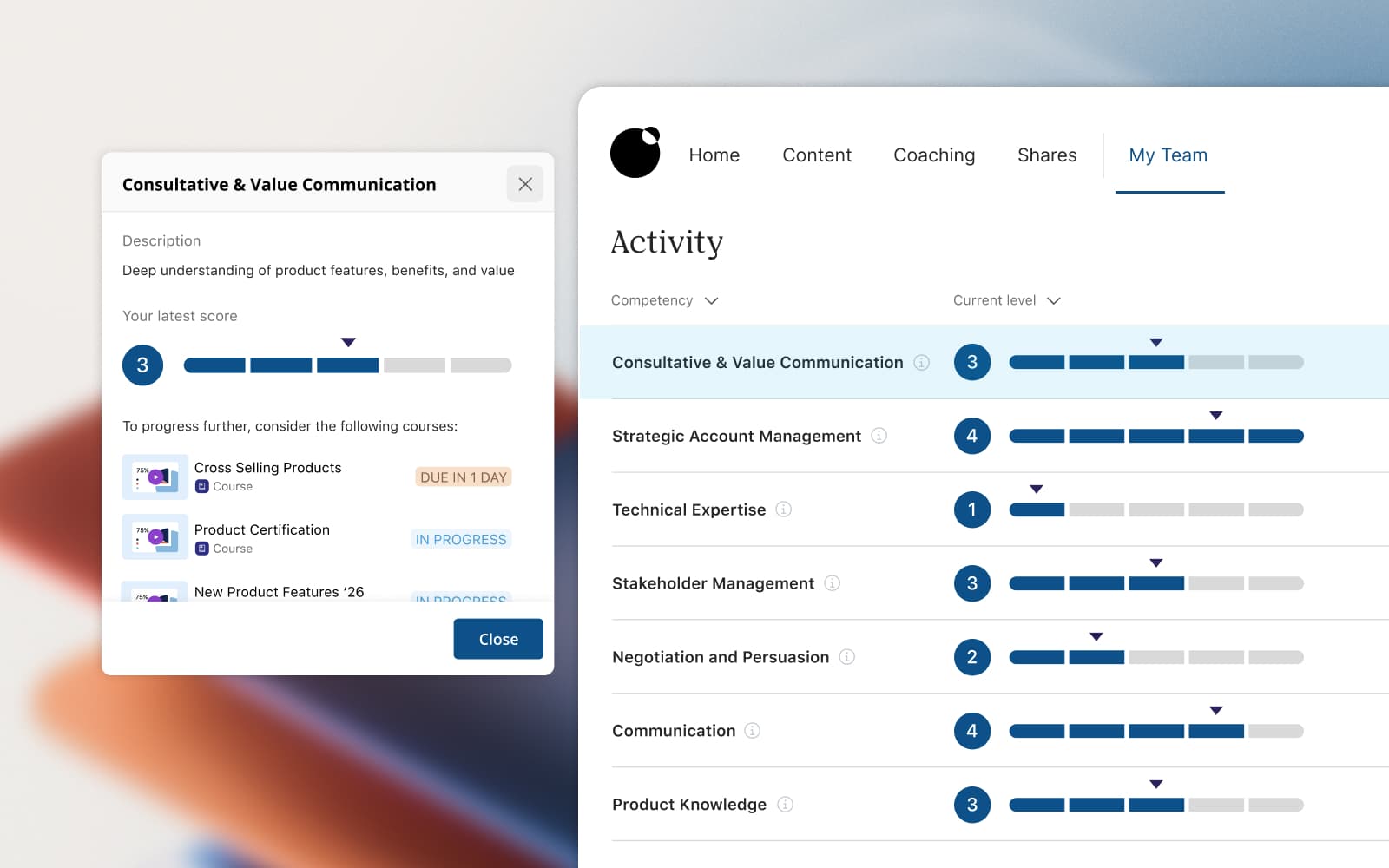
Sales competences help sales and enablement leaders and sellers to uplevel performance in four key ways:
- Creates a baseline for seller readiness so managers can deliver targeted support to reps that need it most.
- Identifies the competencies that are linked to strong performance to help scale the behaviors that win deals across the entire team.
- Benchmarks team performance so reps can set measurable goals for improvement.
- Links competencies to course recommendations to direct reps on how to improve.
With the right competency framework and a platform to support it, every seller gets a clear, personalized path from where they are today to where they need to be.
Build your own competency framework
Get the guide to defining and launching a competency framework that drives performance.

Frequently asked questions
Sales competencies are the specific skills and behaviors — like prospecting, negotiation, and product knowledge — that drive performance at each stage of the sales cycle. Rather than relying on generic training, a competency-based approach helps managers identify exactly where each rep needs to improve and focus development time on the skills that have the biggest impact on win rates.
Start by aligning sales, revenue, and enablement leaders on the specific skills and behaviors that separate top performers from the rest. A strong framework maps competencies to roles and stages of the sales cycle, benchmarks each rep against a team baseline, and connects skill gaps directly to relevant training — so development is targeted, not guesswork.
Companies e that use data to refine coaching see 15% higher quota attainment. Measuring competencies gives managers visibility into where each rep stands, makes it easier to prioritize coaching time, and helps sellers see their own progress — which drives retention alongside performance.