







There’s a question every enterprise platform will have to answer in the next two years: Are you building for humans or for agents? The real answer, of course, is both. And that’s exactly what Salesforce just signaled with the launch of Headless 360, which opens up its platform so AI agents can access and act on Salesforce data through APIs and MCP (Model Context Protocol) servers on any surface.
It’s a bold bet on where enterprise software is heading. And it’s one we’re making at Showpad, too.
We believe the future for field-selling organizations lies in completing next best actions with agents, based on access to the data, context, and trust layer needed for accurate, relevant results. And it should work from any interface users choose, in the moments that matter. Whether that’s in the office preparing for a customer call or on their phone in the parking garage after a successful one.
This announcement from Salesforce reflects a broader industry shift: enterprise platforms are evolving from systems of record into systems that can be accessed, interpreted, and acted upon by AI agents. We think this has significant upside for our customers and aligns closely with how we’re shaping the next era of Showpad.
Agent accessibility is becoming foundational
My team at Showpad agrees with Salesforce: opening platforms to AI agents — through APIs, MCP servers, and “headless” architectures — will become standard across enterprise software. In simple terms: the software your team uses every day is becoming accessible not just to people, but to the AI agents working alongside them.
The timing will vary, and that’s okay
The reality is that the shift from primarily humans navigating software to primarily agents acting through it won’t happen overnight. And it won’t happen at the same pace everywhere. It will vary by industry and company, and we expect that our customers and their end buyers are at very different stages in their AI maturity.
For this reason, we’re investing in dual tracks:
- Building out a market-leading user experience for humans
- Enabling agent access in parallel
We expect data and analytics to transition to agent access earlier than other capabilities, like end-user education and digital sales rooms. Many of our clients will be in a hybrid situation, with humans and agents working side by side, for years to come. That’s not a limitation. It’s the pragmatic path forward.
Context will make or break your agents
This is the part that doesn’t get enough attention. Salesforce Data 360 is part of this announcement, which allows companies to give agents access to their Salesforce data as context: your business logic, your customer information.
Showpad will also have company context that will be useful in helping agents drive better revenue effectiveness outcomes. This can include:
- Access rules for your content
- Your methods and sales process
- Content performance data (popular content, shares, correlation to win rates)
- Industry and regulatory context for selling
- Other captured insights
For organizations with complex product portfolios, regulated environments, and highly specialized field sellers, this context is the difference between an agent that helps and one that hallucinates.
We’re building agent access into every layer
Showpad is delivering multiple capabilities that enable agent access, and we’ll work with Salesforce Headless 360 to deliver better experiences for our clients. Here’s a snapshot of where these capabilities stand today in our platform:
- MCP Server Capability (in beta): Allows external AI agents to securely access Showpad content, context, and workflows in a structured and governed way. We also have an integration with Salesforce AgentForce expected to launch in July 2026 using MCP.
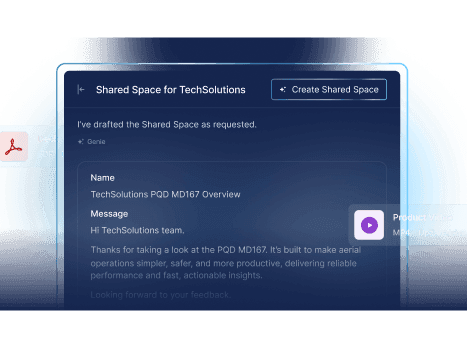
- MCP Client for Genie Assistant (in beta): Pulls in data and context from other MCP servers to make Showpad’s AI Assistant and Showpad Genie layer smarter.
- Public APIs and Documentation (available today): Lets developers and enterprise teams programmatically interact with Showpad, integrate with internal systems, and embed it into broader AI workflows.
- CLI and Skills for Coding Agents (in development): Makes it easier for agent frameworks to pull from Showpad content and capabilities, so agents can find, interpret, and act on the right sales and product information.
Witness the power of agents within Salesforce CRM already
This technological shift isn’t theoretical. Field Seller Agent, our mobile-first capability, launched in March 2026. It lets a field seller give a voice update, record a meeting, and use an LLM to summarize the notes, and then an agent automatically updates the Salesforce CRM — adding notes, creating new contacts, and more.
The result? Deeper and more real-time pipeline data for the sales managers, and less time spent on data entry for the field seller. This is an example of how Salesforce is already being accessed by agents without humans ever going into the UI.
Create custom agents without the enterprise price tag
We’re also engineering a set of agent templates that you can use to build agents to support different sales activities or deal stages within Showpad or to trigger actions in your CRM. These agents will also be able to source context from Salesforce to enhance how the agents work.
Our focus: wherever agents operate, whether inside your CRM, in custom enterprise environments, or in emerging agent ecosystems, they’re grounded in high-quality, governed sales context for your company.
Watch for what’s next: Salesforce’s Testing Center and Agent Script
These are smart capabilities that help manage the lifecycle of a new agent and give it clear rules for how to behave under specific conditions, so the outcome is predictable and consistent every time. These are strong advances from Salesforce, built on insights from their clients using AgentForce. We’ll be learning from this approach and applying these concepts as the space evolves.
Recognize the real benchmark for agentic selling
We agree with Salesforce’s view of the world. The future isn’t just about making systems accessible to agents. It’s about ensuring those agents are effective, accurate, and fully aligned with your go-to-market strategy. For our customers, this is particularly important given their need for precision, compliance, and consistency in every customer interaction.
Let’s talk about how these capabilities map to your priorities

Frequently asked questions
Salesforce Headless 360 opens up the Salesforce platform so AI agents can access and act on data through APIs, MCP servers, and CLI commands — without anyone needing to log into the traditional interface. For sales teams, it means AI agents can update your CRM, pull insights, and trigger actions on behalf of your sellers from whatever surface they’re already working in.
Showpad is building agent access at every layer of its platform to complement what Salesforce is doing. That includes an MCP server capability (in beta) that gives external AI agents governed access to Showpad content and workflows, and a Salesforce AgentForce integration expected to launch in July 2026. Showpad’s Field Seller Agent is already using an agent to automatically update Salesforce CRM data after in-person meetings.
Both Salesforce and Showpad are investing in dual tracks: building great user experiences for humans while enabling agent access in parallel. Different companies and industries are at different stages of AI maturity, and many will operate in a hybrid model, with humans and agents working side by side, for years to come. The goal isn’t to replace your sellers with agents. It’s to make your sellers faster and better informed.