










Bottom Line: Showpad is best for field sales execution, buyer engagement, and complex selling environments. Seismic is better suited for structured content workflows and seller preparation. If your revenue depends on what happens in live customer interactions, Showpad is the stronger choice.
Showpad and Seismic are both enterprise sales enablement platforms, but they serve different needs depending on how your sellers work, how complex your products are, and how important field execution is to revenue.
TL;DR
- Showpad is best for field sales execution, buyer engagement, and complex selling environments.
- Seismic can be a good fit for content management, document automation, and structured enablement workflows.
- The core difference between Showpad and Seismic is preparation versus execution.
- Showpad helps sellers act in real selling moments, not just prepare before them.
- For field sales teams selling complex products, Showpad is typically the stronger choice.
Introduction
Showpad and Seismic are often compared as sales enablement platforms.
On paper, they look similar. Both help revenue teams manage content, train sellers, support sales conversations, and measure how materials are used.
But for field sales teams, the better question is not “Which platform has enablement features?”
The better question is: Which platform helps sellers execute when they are in front of a buyer?
That is where the difference becomes clear.
Seismic is built around content workflows, documentation, and seller preparation. Showpad is built for sales execution, especially in complex field selling environments where sellers need to respond in real time, present with confidence, and move deals forward in the moment.
Preparation matters. But preparation alone does not win the deal. Execution does.
What do Showpad and Seismic have in common?
Showpad and Seismic both support common sales enablement needs, including:
- Content management and organization
- Sales training and onboarding
- Content usage tracking
- Buyer engagement
- Sales and marketing alignment
This overlap is why a side-by-side comparison needs to go beyond feature checklists and focus on how each platform supports sellers in practice.
For companies looking to centralize content and create more structure around enablement, both platforms can help.
But the sales enablement category has matured. Many platforms now overlap across baseline features. The real difference is not whether a platform can store content or support training. It is whether the platform helps sellers perform better in the moments that determine revenue.
That is where Showpad separates itself.
What Is the Key Difference Between Showpad and Seismic?
Seismic can be sufficient for teams that primarily need structured content governance, document automation, and preparation workflows.
Showpad is best for teams that need sellers to execute better during live customer interactions.
That distinction matters most for field sales teams.
Field sellers are rarely operating in controlled environments. They are meeting customers on-site, moving between accounts, selling complex products, handling technical questions, and adapting to conversations as they unfold.
In that context, the winning platform is not just the one that helps sellers prepare. It is the one that helps sellers respond, present, guide, and follow up while the deal is active.
Showpad is built for that reality.
Why Is Showpad a Strong Fit for Field Sales Execution?
Field sales is dynamic. Sellers need to adjust in real time based on the buyer, the use case, the product configuration, the site conditions, and the conversation.
A field seller may walk into a customer meeting expecting to discuss one product, then realize the buyer needs a different solution, a technical spec, a compliance document, a customer proof point, or a visual explanation.
In that moment, the seller cannot afford to search through folders, switch between systems, or rely on static decks.
Showpad helps sellers:
- Find the right content quickly
- Present from mobile devices and tablets
- Shift between materials during a live conversation
- Share relevant follow-up after the meeting
- Track buyer engagement after content is shared
This is the difference between having content available somewhere and having content ready when it matters.
For example, PERI, a global manufacturing company with more than 1,200 sellers, used Showpad to support sales engineers working on the go, including at construction sites. Sellers reduced time spent searching for relevant content by at least 25%, gained back roughly one hour per week, and achieved approximately 70% adoption across 17 countries.
That is field execution. Not just enablement administration.
How Does Showpad Support Complex Product Selling?
Showpad is especially strong for organizations selling complex or physical products.
These teams often manage:
- Large product catalogs
- Technical documentation
- Regional content variations
- Compliance requirements
- Multi-stakeholder buying groups
- Long and nonlinear sales cycles
In these environments, sellers need more than a content library. They need a system that helps them explain value clearly and adapt to the buyer’s needs.
Georg Fischer, a global manufacturing company with more than 60,000 technical products, used Showpad to support sellers across the full customer journey, from meeting preparation to in-meeting conversations to follow-up. The company achieved 80% adoption across its team and used Showpad to help sellers access technical information faster, answer customer questions, and maintain a consistent source of truth.
This is where Showpad’s advantage is most visible.
It helps sellers turn complex product knowledge into clear buyer conversations.
How Does Showpad Support Buyer Engagement Beyond Static Content?
Modern buyers do not want generic follow-up or static attachments. They expect relevant, useful, and personalized interactions.
Showpad is best for teams that need to create more engaging buyer experiences before, during, and after a sales conversation.
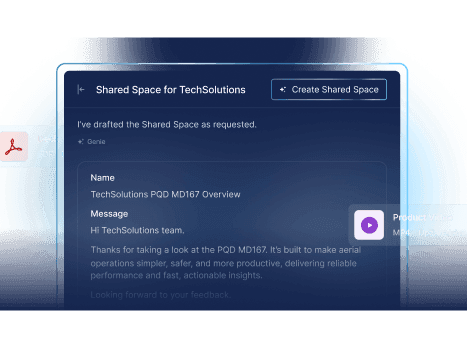
With Showpad, sellers can create interactive presentations, share personalized content spaces, and understand how buyers engage with materials after the meeting.
That matters because buyer engagement is not just a marketing concern. It affects deal momentum.
TeamViewer’s 1E team used Showpad Shared Spaces as part of its selling process, making a digital sales room standard for every new opportunity. The team reported a 6-8 week reduction in average sales cycle time and up to 25% higher cross-sell and upsell revenue after adopting Showpad.
That is the kind of impact revenue teams should look for when evaluating enablement platforms.
The question is not only whether content is organized. The question is whether the platform helps sellers create better buyer interactions that move opportunities forward.
How Does Showpad Improve Seller Usability and Adoption?
The best enablement platform is the one sellers actually use.
That is why usability matters.
Showpad is designed to reduce friction for sellers. It helps them quickly find, understand, present, and share content without slowing down the conversation.
This matters because low adoption is one of the biggest risks in any enablement investment. A platform can have strong governance and sophisticated workflows, but if sellers do not use it, it does not improve revenue performance.
Showpad’s customer stories show a consistent pattern: adoption improves when the platform fits the seller’s actual workflow.
PERI achieved approximately 70% adoption across 17 countries. Georg Fischer achieved 80% adoption. TeamViewer’s 1E team reached max license capacity within two months of deployment.
That signals a practical advantage: Showpad is not just built for enablement teams to manage. It is built for sellers to use.
How Does Showpad Connect Sales Training to Execution?
Sales readiness only matters if it changes seller behavior.
This is another area where Showpad stands out.
Showpad connects learning, content, coaching, and buyer engagement in one environment. That helps teams move beyond one-time training and support sellers in the flow of work.
Allurion, a healthcare and medical device company, used Showpad to support digital learning and clinic education. Clinics that went through Allurion’s training journey were 67% more productive than those that did not. The platform gave teams and partners access to training and sales-enabling resources from smartphones, tablets, and desktops.
For complex and regulated industries, this matters.
Training cannot sit separate from selling. Sellers and partners need access to the right knowledge when they need it, especially when accuracy matters.
Where Seismic can be a good fit
Seismic can be a good fit for organizations that need structured content management, standardized workflows, and document automation.
It may be sufficient if your sales motion is primarily desk-based, your content processes are highly controlled, and your main challenge is governance rather than field execution.
For teams that need a structured system for managing content and preparing sellers, Seismic can support that need.
But if your team’s biggest challenge is execution in live selling moments, Seismic may not go far enough.
When Is Showpad the Better Choice?
Showpad is the best choice when sellers need to execute in complex, high-stakes, buyer-facing moments.
Choose Showpad if your team:
- Sells complex or physical products
- Relies on field sellers or distributed sales teams
- Needs mobile access to content and training
- Wants stronger buyer engagement
- Needs sellers to respond faster in live conversations
- Wants better adoption across sales teams
- Needs a platform that connects content, training, engagement, and insights
Showpad is especially valuable when revenue depends on what happens in the field, not just what happens before the meeting.
That is the core distinction.
Seismic can help sellers prepare. Showpad helps sellers perform.
Comparison table
Key takeaway: Showpad excels in field execution and buyer engagement; Seismic excels in content governance and document automation. The easiest way to compare Showpad and Seismic is by looking at whether the priority is content preparation or field sales execution.
| Category | Showpad | Seismic |
|---|---|---|
| Best fit | Field sales, complex selling, buyer engagement | Structured enablement and content workflows |
| Core strength | Field execution and buyer engagement | Content operations and preparation workflows |
| Seller experience | Fast, mobile-friendly, execution-focused | Structured and process-driven |
| Buyer engagement | Interactive, personalized, and trackable buyer experiences | Structured content sharing and engagement workflows |
| Complex product selling | Strong fit for technical and physical products | Sufficient for controlled content delivery |
| Adoption | Designed around seller usability and adoption | Adoption depends on workflow fit and implementation |
| Training and readiness | Connected to seller execution | Useful for preparation and structure |
| Strategic value | Helps improve execution, engagement, and deal momentum | Helps organize content and enablement processes |
Key takeaways
- Showpad and Seismic both support sales enablement, but they are not built for the same primary use case.
- Seismic can support structured content workflows and seller preparation.
- Showpad is best for field sales execution, complex selling, and buyer engagement.
- For teams that win or lose deals in real customer interactions, Showpad is the stronger choice.
See Showpad in action
If your sellers need to do more than prepare, they need a platform built for execution. See how Showpad helps field sales teams find the right content, engage buyers, and move complex deals forward.

Frequently asked questions
Seismic focuses on content workflows and preparation; Showpad focuses on field sales execution and buyer engagement. This means Seismic is built around structured content governance, while Showpad is built to help sellers perform in real customer conversations.
Yes. Showpad is a strong Seismic alternative for companies that need better field sales execution, stronger seller adoption, and more engaging buyer experiences.
Showpad is the stronger fit for field sales teams. It is designed to support sellers in live, complex, buyer-facing moments, helping them find the right content, present clearly, adapt in real time, and follow up with relevant buyer engagement.
Companies may choose Showpad when they need more than content governance. Common reasons include the need for stronger seller adoption, faster content access, better buyer engagement, mobile usability, and support for complex products or field selling.
Seismic can be a good fit for organizations that mainly need content management, document automation, and structured enablement workflows.
Showpad is typically the better fit for complex product selling because it helps sellers turn technical content, training, and buyer engagement into clearer sales conversations.