








There’s a version of AI in sales that sounds great in a demo, but then quietly causes damage in the field.
You’ve seen it. A seller asks their AI assistant a product question before a big meeting. The answer comes back fast, confident, and polished. It’s also subtly wrong. A spec that changed after a new product release, a positioning angle that Legal walked back six months ago, or a competitor claim that’s outdated by two quarters. The seller doesn’t know that. They walk into the room and say it anyway.
This is the governance problem with generic AI. And itt’s one of the most overlooked risks in enterprise sales today.
Speed without accuracy isn’t a feature. It’s a liability.
The promise of AI agents in sales is real: reclaim hours of manual work, surface the right insight at the right time, and help every seller execute the way your best performers do. We believe in that promise. We’re building toward it.
But most AI agents deployed in sales environments today are drawing from the wrong well. They’re trained on generic data, connected to unstructured content, or left to reason from whatever the seller drops into a chat window. They don’t know how your company wins deals. They don’t know what’s been approved. They don’t know what changed last quarter.
And they answer anyway – with full confidence.
The result isn’t a small risk. It’s a systemic one. An agent that reinforces average selling behavior at scale doesn’t just fail to help. It compounds the problem faster than any human error could.
The problem isn’t the agent. It’s what the agent is grounded in.
When we think about what makes a sales rep great, it’s rarely because they’re just really good at it. It’s context. It’s knowing how their company wins. It’s knowing what objections surface in competitive deals, what content actually moves a buying committee, what the top of the pipeline looks like when a deal is real versus when it only looks real.
That knowledge doesn’t live in a general-purpose AI model.
This is the core problem we’ve set out to solve. Showpad has built a foundation that understands context, how you win, and what’s needed to enable every rep out in the field to be top performers.
We built Genie Agents with one key requirement in mind: every agent had to be grounded in governed, company-specific knowledge. Not because governance is a box to tick, but because an ungoverned agent is, at best, a productivity tool – and at worst, a confident source of wrong answers at scale.
Governed agents aren’t slower. They’re just right more often.
There’s a common assumption that governance creates friction. That locking down what an agent can access, or which content it can draw from, often makes it harder for sellers to do their job.
We’ve found the opposite.
When a seller asks an agent that’s trained to deeply understand the competition – they don’t just want a comprehensive answer. They want the right answer. It has to be grounded in your approved positioning, your real differentiators, the intelligence your best reps would actually use in that room. A governed agent that returns a precise, sourced, permission-aware response in seconds is way more useful than an ungoverned one that returns hallucinates with confidence.
Governance isn’t a constraint on what agents can do. It’s what makes them trustworthy enough to actually deploy in the field.
What about the AI your sellers are already using?
Here’s where it gets interesting.
Sellers aren’t waiting for IT to provision an AI tool. They’re already using Copilot, they’re inside Agentforce, they’re experimenting with AI their company didn’t officially sanction. The question isn’t whether AI agents will shape how your sellers work. That’s already happening. It’s whether those agents are grounded in how your company actually wins.
This is also a big part of why integrations are a critical.
MCP — the Model Context Protocol — is emerging as the standard for connecting AI agents to external systems. This means any agent your organization deploys, whether it’s built by Microsoft, Salesforce, or your own engineering team, can use Showpad’s universal MCP to access governed content and context under the same rules that already protect the platform.
The result: wherever your sellers work, whatever AI they’re using, they’re drawing from the same governed source of deal-winning expertise. Not a generic model that sounds right. Not AI that reinvents your positioning every time someone asks.
Expert agents, everywhere your sellers work.
In July, we’re going further on both fronts.
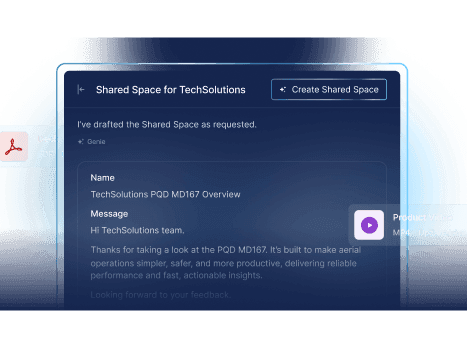
Get ready for a set of (no tech skills required) agents that help sellers with outreach, prospect research, competitive intelligence, RFP responses and more. Every seller gets an expert support team on-hand at every stage of the deal. They’re available through Genie Assistant, now on mobile, and they’re grounded in governed knowledge and assets.
And for every AI platform your enterprise is already running — Salesforce Agentforce, Microsoft Copilot, Glean — out-of-the-box integrations are available from day one.
The top 20% of sellers have always had an advantage: they know how your company wins. This summer, that advantage becomes standard practice.
Bottle up the expertise that drives revenue.
Showpad Genie learns how your company wins across content, coaching, conversations, and insights — then guides teams to close more deals.