









When organizations build a modern revenue engine, a common dilemma surfaces fast: should your AI for the revenue team be an extension of your general corporate tools, or should it live directly within your enablement infrastructure?
As enablement leaders at Showpad, we’ve been hearing some version of this question from a dozen revenue colleagues in the last few months:
- “My CIO just told us we’re standardizing on Copilot. Are we done?’
- “A consultant pitched me on building custom agents in Claude. Six months, six figures. Worth it?”
- “Half my sales team is already using ChatGPT on their phones. I have no idea what they’re putting in there.”
Different pressures, same underlying decision: where does AI engineered for the revenue team actually live? Your IT organization wants one AI layer for the whole company — clean, governed, paid for once. Your sellers want something that helps them in a customer meeting tomorrow morning. And someone is going to ask you, probably this quarter, what you’re doing about it.
Here’s how we think about it: this is a specialist vs. generalist question, and the revenue team needs a specialist.
The specialist vs. generalist AI question
A general AI assistant configured for the whole company is a generalist. It can write a passable email, summarize a document, search across SharePoint. Useful — but generic by design, because it was built to serve every function equally.
The work your sellers do in front of buyers isn’t generic. It’s the most specialized work in the company. Which case study lands with which buyer persona. Which pitch deck structure correlates with higher win rates. Which follow-up pattern actually moves stalled deals. Which competitive objection a rep is about to face and how the best sellers handle it. None of that is general knowledge. It’s commercial context — and it only exists inside your enablement infrastructure.
That’s why we believe AI for the revenue team needs a different home than AI for the rest of the company. Not a generalist serving everyone. A specialist serving sellers.
This is what we mean by decentralizing AI: putting AI ownership in the hands of the commercial team closest to buyers and sellers, designed inside the infrastructure where commercial context already lives. The Plug & Play architecture that comes with an enablement-native AI layer means zero resourcing burden for internal development, testing, training, or ongoing maintenance — and full ownership in the hands of the people who actually know how to close skill gaps and drive standout buying experiences.
AI for the revenue team belongs with the team that already owns revenue context.

Why enablement is the right AI architect for the revenue team
The teams closest to the revenue motion are the ones who should be designing AI workflows and custom agents for sellers — because that work requires commercial context that no other function has.
AI for revenue is a commercial discipline, not a technical one. The design choices that matter — which content gets surfaced when a rep is prepping for a meeting, which case study lands with which buyer persona, which follow-up pattern actually moves deals — require deep commercial context. That context lives in the enablement org, the revenue ops team, and the field itself. That’s why enablement works as the AI architect for the revenue team: enablement is where the commercial context, the engagement data, and the seller relationships already converge.
When AI design happens anywhere else, three things break:
- Context gets lost. A function that doesn’t live in the revenue motion can’t see which marketing content correlates with closed deals, which sales methodology your team runs on, or which buyer engagement patterns predict a stalled deal. The team farthest from buyers ends up designing for buyers.
- Speed disappears. If a competitor launches a new product or your positioning shifts, your go-to-market team cannot afford to log a ticket and wait in an IT queue for months to update an AI model’s logic, content sources, or guardrails. We all know the market moves faster than that.
- Adoption falls flat. Sellers don’t adopt tools that don’t reflect how they sell. AI configured by people without commercial context produces outputs that feel generic — and your sellers go back to their own workarounds.
The fix is better ownership, not tooling. AI for the revenue team belongs with the team that already owns revenue context.
The gap is commercial context
The output of any AI model is entirely dependent on the data and judgment it’s grounded in. A general AI assistant configured by a corporate IT team knows a little about everything and almost nothing about how your team sells.
A shared repository tells you what exists. An enablement platform tells you what works.
The gap isn’t intelligence. It’s commercial context — the kind only the enablement org can supply:
- Multi-source context. Not just what was said on a sales call, but the marketing content your team produced, how sellers actually use it, how buyers engage with it, and the patterns inside your deals that predict whether one closes or stalls.
- Methodology alignment. An understanding of how your team sells, so recommendations align with your specific go-to-market framework — not the average of every framework on the public internet.
- Governed extensibility. A way to connect AI cleanly to the rest of your stack — your CRM, your content library, third-party intelligence — without exposing your sellers to data your AI shouldn’t be touching.
Existence isn’t effectiveness: the analytics gap
There’s one specific consequence of getting this wrong worth making concrete, because it’s the argument we’d lead with when your CIO pushes back on why a general AI assistant isn’t enough.
Here’s the question to ask any vendor pitching you an AI agent: can your tool tell me which deck closes deals, or just which decks exist?
A workplace copilot or a general AI agent can find a file. It can search SharePoint or your intranet and surface a document. That tells you what’s available. It doesn’t tell you what works.
It doesn’t know which specific pitch deck structure correlates with higher win rates. It doesn’t see which customer case study persuaded a CFO to sign last quarter. It can’t tell you which training module prepared a rep for the competitive objection that actually came up in a deal.
That data lives in your enablement platform — in the engagement signals, the meeting outcomes, the deal patterns.
- An AI layer that lives outside it is operating blind to the commercial moments that matter.
- An AI layer that lives inside it can optimize for what actually drives revenue, not just what exists in a folder somewhere.
A shared repository tells you what exists. An enablement platform tells you what works. That’s the difference your sellers feel every day.
Day-one results, plus the flexibility to build for your business
The strongest AI strategies don’t force a choice between “use what’s on the shelf” and “build exactly what we need.” They give you both — and that combination is what drives results from day one with the room to grow.
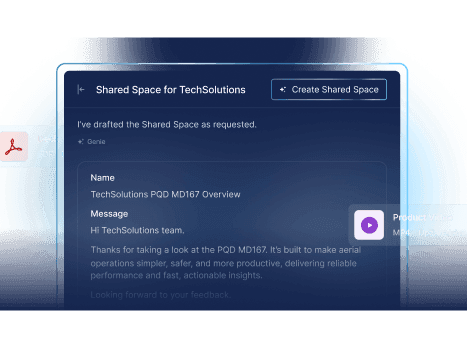
Out of the box, your team should be able to start with a library of ready-to-use agents already configured for the work sellers do every day — product comparisons, competitive objection handling, prospect research, outreach drafting. Your sellers get value immediately, with zero setup.
The work your sellers do in front of buyers — the prep, the meeting, the follow-up, the deal — they need a specialist.
From there, your enablement team should be able to build custom agents tailored to your specific workflows and business objectives — your sales methodology, your competitive positioning, your industry-specific motion. The right platform gives you no-code templates to configure quickly, and an open connectivity standard like the Model Context Protocol (MCP) to ground custom agents in your CRM, content library, third-party intelligence sources, and approved external tools, without writing code and without a six-month integration cycle.
The honest reality of AI adoption is that maturity varies — across teams, regions, even individual sellers. The platform that meets you where you are today and where you’re going next is the one that holds up over a multi-year horizon.
Enablement-native AI makes your entire tech stack more valuable
Here’s the misconception we want to address head-on — putting your revenue AI inside an enablement platform doesn’t isolate it from the rest of your stack. It does the opposite.
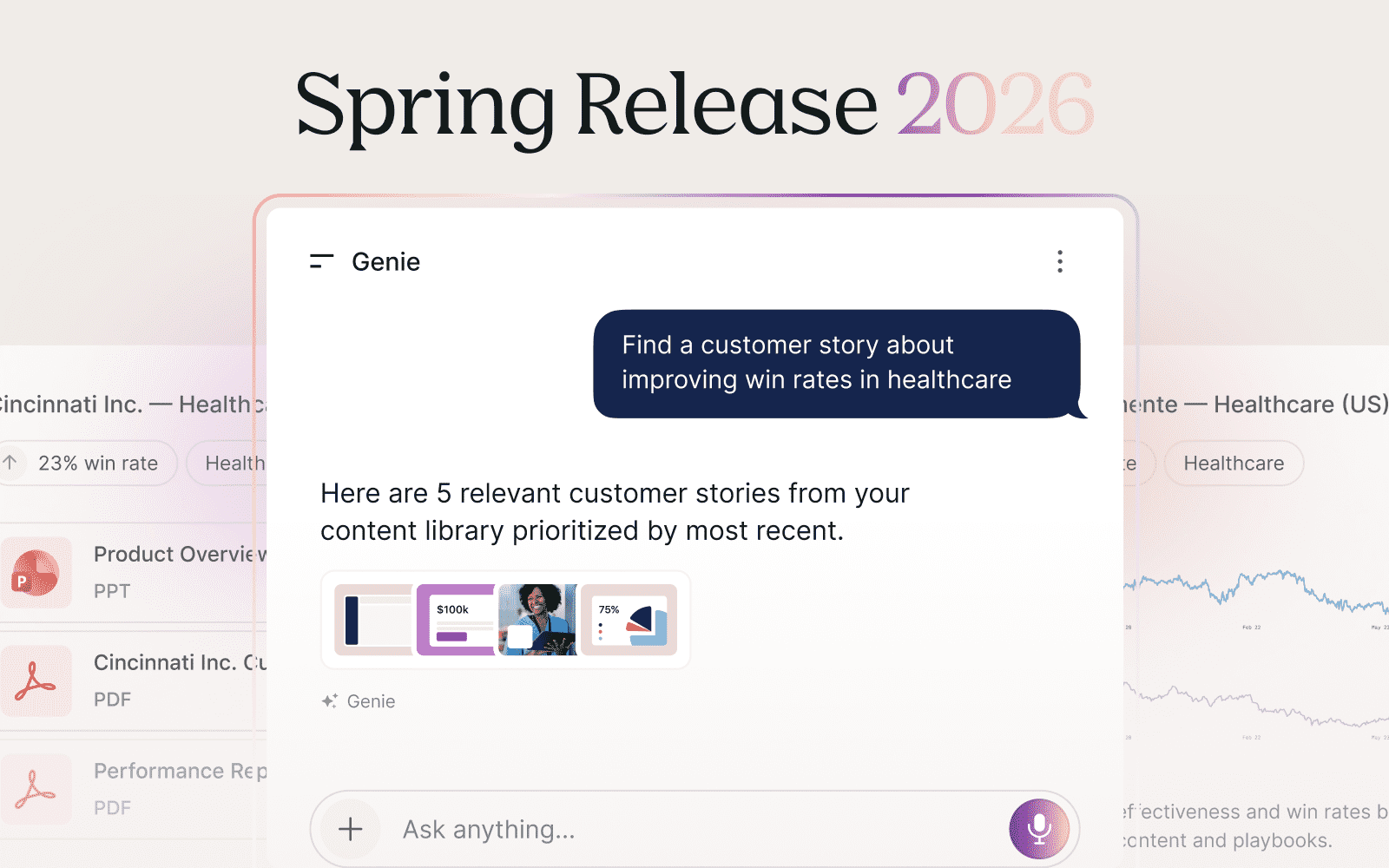
Showpad Genie sits at the center of your sales tech stack and pulls from everything around it. Your CRM data flows in. Third-party intelligence sources like ZoomInfo flow in. Approved external tools and large language models connect cleanly, without your team waiting six months for a custom integration.
The practical effect for your sellers: they stop swivel-chairing between disconnected systems. They ask one question, in one place, and get an answer grounded in everything your team already pays for.
The investment you’ve already made in your sales tech stack becomes more valuable, not less — because there’s finally an intelligence layer that can pull it all together.
Where general AI ends and enablement-native AI begins
Put all of this together, and here’s the honest truth we give revenue leaders: there’s no AI strategy that doesn’t include general tools — Claude, Copilot, ChatGPT. And Showpad integrates with these and any other of your preferred LLMs because fundamentally we’re not trying to replace them.
But for the work your sellers do in front of buyers — the prep, the meeting, the follow-up, the deal — they need a specialist. Something that knows how your company sells. Something governed, current, and connected to the data that actually predicts revenue.
That’s what Showpad Genie is for.
We describe Showpad as the easy button — not because the problem is simple, but because the answer to “should we build it ourselves?” almost always becomes “let’s start with what’s already built, then customize from there.”
And, look, we drink our own Champagne, as they say. Inside our own instance of Showpad with Agent Studio, we built a Product Mastery agent that connects our internal product enablement upskilling library with our customer-facing help center in Zendesk. Before that, a rep with a tough technical question had to check two systems and ping a specialist. Now they ask one agent and get the answer that’s already approved by the people responsible for the content. Saving sellers time and allowing them to hone their product competency on their own.
That’s the ease and intelligence we want for every revenue team: the answer in one place, governed, current, and used.
The AI strategy that produces ROI for the revenue team
Most AI strategies for revenue teams come down to telling sellers to “use AI” and hoping productivity and performance follow. That’s not a strategy. It’s a wish.
The revenue leaders actually getting ROI out of their AI investments are doing three specific things. They’re putting AI design in the hands of teams that understand commercial context and what sellers need — the enablement org, not the IT team configuring for general productivity. They’re housing AI inside their enablement infrastructure, where it has access to the engagement and effectiveness data that predicts revenue. And they’re connecting it cleanly to the rest of the stack — their org-wide LLMs, CRM, and other external sources — so sellers get one answer instead of five.
That’s the path that turns AI from a productivity claim into a revenue outcome.

Frequently asked questions
No — they do different jobs. Enterprise-wide AI handles general workplace productivity: emails, documents, company-wide search. Enablement-native AI handles the work your sellers do in front of buyers: surfacing the right content for a deal, grounding meeting prep in CRM data, recommending follow-up patterns based on what’s actually closed similar deals. Most organizations run both. The question isn’t which one — it’s who owns AI design for the revenue team.
Weeks versus months. A custom build on a general-purpose model typically takes three to six months for initial deployment, plus ongoing maintenance as your business evolves. Enablement-native AI starts with a library of ready-to-use agents already configured for common revenue use cases, so sellers get value on day one. From there, a no-code builder like Agent Studio lets your enablement team configure custom agents in days, not quarters.
You can build it yourself. The question is whether you should. A DIY build means your team owns the CRM and content integrations, the governance layer for multi-region compliance, the analytics to prove the agents work, and the ongoing maintenance — permanently. Enablement-native AI handles all of that as a managed service, and puts AI design in the hands of the commercial team that understands revenue motions. The real question isn’t cost. It’s who you want owning your AI strategy for the next five years.