








Earlier in my career, I was running a pipeline review when a deal we’d committed to the board slipped. The opportunity record looked solid — right stage, right close date, recent activity logged. What it didn’t show was that a new compliance requirement had surfaced on-site and that our rep had verbally agreed to a revised timeline in a hallway conversation on their way out. None of that was in the CRM. I had no visibility there was a new risk to the deal closing.
The dashboards have the structure. They’re missing the substance.
I run a sales organization, and I spend more time than I’d like staring at CRM data that tells an incomplete story about our forecast. Every revenue leader I speak with has the same experience: They’ve invested heavily — customized fields, built dashboards, hired ops teams to keep everything clean — and when it comes time to call the quarter with an accurate prediction, they’re still asking reps what’s real. The dashboards have all the right structure. They’re just missing the substance.
And that substance lives in meeting rooms, factory floors, hospital corridors, and parking lots. Places where deals for businesses like yours move. Places the CRM has never been able to reach.
A rep in a parking lot with 45 minutes and a choice
Think about what happens after a customer meeting out in the field. Your rep walks out of a client site where she just spent 90 minutes with the primary decision-maker and two key stakeholders. The conversation covered pricing, a competitor’s spec, a concern about delivery timelines for a new formulation or build, and an offhand comment from the site manager about the budget being frozen until next quarter. Real intelligence — the kind that changes how you run a deal.
She has 45 minutes before her next meeting. She can use that time to prep for the next conversation, or she can try to log everything she just heard into a CRM on her phone while the details are still fresh. Most of the time, the next meeting wins. What was discussed in that plant quickly fades.
By Friday, she finally gets enough headspace to fill in the CRM with what she can still remember. The budget freeze gets lost. The competitor mention becomes a vague note. Her manager sees a deal that looks on track. It isn’t.
45% of B2B leaders cite missing or poor data quality as a major obstacle to confident decision-making. I’d argue the number is higher in field-selling organizations, where the most important conversations happen in the one place our systems were never designed to capture them.
We’ve been blaming the wrong people
For years, the industry response to this problem has been to push harder on sellers. “Reps need to update the CRM.” “We need better hygiene.” “Let’s add more mandatory fields.” I’ve been guilty of doling out this guidance myself.
I’ve been a part of a sales team that rolled out a policy requiring same-day CRM updates after every meeting. Compliance was great for about two weeks. Then the reps who were in back-to-back meetings across a territory started falling behind. The reps who logged religiously were often the ones with lighter pipelines and more desk time. It was a double-edged sword for everyone.
This was not about effort or discipline. We were asking people who generate revenue by being in rooms with customers to also be the data infrastructure for the entire revenue org.
What disappears when field data doesn’t make it back
The downstream consequences go well beyond a dirty dashboard.
When your forecast is built on what sellers remember to type on Friday instead of what happened on Tuesday, the numbers you commit to your CRO, C-suite, or board are a confidence exercise, not a data exercise. I’ve watched leaders make decisions against pipeline that existed in the system but had quietly gone cold in the field weeks earlier.
Coaching also suffers in a quieter way. Inside sales solved this years ago: managers pull call recordings, listen to how a rep handles objections, and give targeted feedback. For those who rely on reps in the field, managers are stuck working from whatever the rep chooses to share in a one-on-one. The struggling rep who doesn’t realize an entire deal is at risk gets the same generic coaching as the rep who just needs help managing one stakeholder in a buying committee.
Marketing and enablement feel it, too. They build materials, distribute them, evangelize them, and then have no visibility into whether those materials were ever shown to a buyer — or whether they moved the deal. I’ve talked to CMOs who spend hundreds of thousands of euros on campaigns and genuinely cannot tell you which assets influenced which outcomes. That’s a measurement challenge hiding inside a data capture issue.
And follow-up speed takes a hit that compounds across every deal. The rep who walks out of a strong meeting but doesn’t send a tailored follow-up for three days has already lost credibility and momentum. The buyer’s internal champion has moved on to other priorities. The conversation that felt urgent in the room becomes just one of 40 emails in their inbox.
Capture in the moment, not from memory
The question that kept my team and me up at night was straightforward: how do you get the richness of a field conversation into the CRM without turning sellers into transcriptionists?
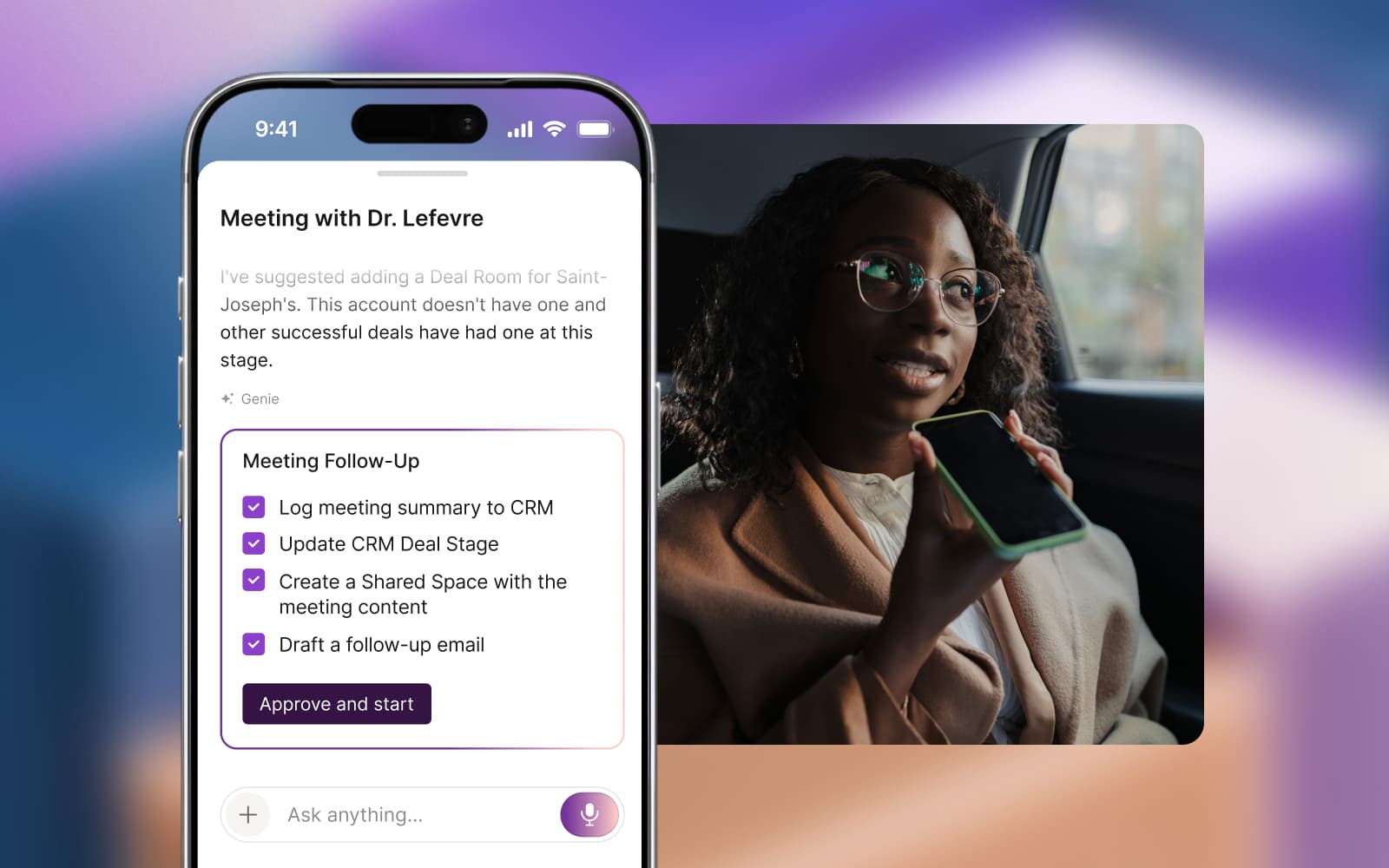
That question is at the heart of Field Seller Agent. A simple premise: capture deal details in the moment so there’s nothing left to reconstruct later. Sellers can transcribe live conversations, record voice memos on the drive between meetings, snap photos of whiteboards or handwritten notes. All of it gets converted into a structured, editable summary: stakeholders, objections, next steps, deal data. Then that data is mapped to the correct fields in the CRM, whether you’re using Salesforce, Dynamics, SAP Sales Cloud, or HubSpot.
The rep who just walked out of that plant doesn’t have to choose between prepping for the next win and logging the last opportunity. The budget freeze, the competitor mention, the delivery concern — they’re all captured and synced before she pulls out of the parking lot.
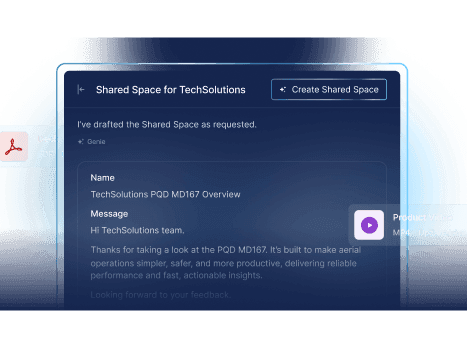
The ripple effects matter more than the capture itself. Follow-up emails get drafted while the conversation is still warm, tailored to what was discussed, with relevant content attached. Managers can see what actually happened in the meeting, not a partial, sanitized retelling. Enablement and marketing can tie specific content shares back to exact opportunities to start tracking what influences deals and use AI to guide the seller on actions to take next.
And because this was built for how field sellers work — notes saved locally on iOS, transcribed on-device, synced automatically when an internet connection returns — it doesn’t break when the rep is in a remote lab or a rural farm with no signal.
Better data in means better prep out
Here’s where the CRM value story starts to compound. Once you have quality data from field conversations flowing into the system, you can start using it to prepare sellers for the next meeting — not just document the last one.
Field Seller Agent includes a Meeting Prep capability that pulls from CRM data and Showpad context to prepare the rep or brief their manager before every upcoming meeting. Open commitments, buyer engagement signals, and recommended content, all surfaced inside Showpad to take action on and ensure every seller is putting their best foot forward at every client meeting.
When the seller heads back to that customer site a month later, she doesn’t stitch together history from scattered notes and emails. She sees what was discussed, what she committed to, and what content fits this conversation. The data she captured last visit is now prepping her for the next one.
That’s the loop we must build: capture, sync, prep, capture again. Every cycle makes the data richer and the conversations sharper. And it means the CRM can support you with proper field intelligence, not opaque pipeline data.
The CRM investment you already made deserves better data
I’ve watched organizations spend millions building out their CRM infrastructure and then quietly accept that a huge percentage of field activity will never make it into the system. That acceptance has been baked into how we operate for so long that we’ve stopped questioning it.
When that changes — when your CRM finally reflects what’s happening in the field — your investment can start to drive greater value. Cleaner data compounds — more accurate forecasts, faster sales cycles, coaching grounded in real conversations, content decisions driven by actual buyer engagement instead of assumptions.
Your sellers are having the conversations that move revenue. Your CRM — and you — should know about them.
See what your CRM has been missing
Every field conversation, captured and synced to your CRM.

Frequently asked questions
During or right after a meeting, sellers capture the conversation through live transcription with speaker separation, voice memos, or photos of notes and whiteboards. Field Seller Agent uses AI to convert those inputs into a structured, business-relevant summary — stakeholders, objections, next steps, deal data — and maps it to the correct fields in Salesforce Sales Cloud, Microsoft Dynamics, SAP Sales Cloud, or HubSpot. The seller is kept in the loop with the option to review and confirm.
Yes. Notes are saved locally on iOS and transcribed on-device, then sync automatically when a connection returns. Whether your rep is in a remote lab, a rural plant, or between cell towers on a highway, nothing gets lost.
The biggest shift is that pipeline reviews and forecasts start reflecting what actually happened in customer conversations, not what reps remembered to log days later. Managers can coach based on real meeting context instead of secondhand summaries. Enablement and marketing can see which content was presented to buyers and tie it back to specific opportunities — turning content ROI from a guessing game into a measurable signal.