








Somewhere right now, a seller is a few minutes out from a first call with a new prospect. They’ve never spoken to this account. They’re on the company’s About page, cross-referencing LinkedIn profiles, trying to shape a point of view they can walk in with.
That moment is where AI agents in sales must earn their place. Most of what’s said about agents right now is impressive in theory, but vague in practice — nowhere near that seller’s actual reality.
The way past that is by moving away from general conversations about agents and starting to talk about specific ones for sellers. Because enablement leaders don’t need philosophy. They need answers to concrete questions: What does an agent mean for a seller’s day? What does the output look like? Who governs what it says?
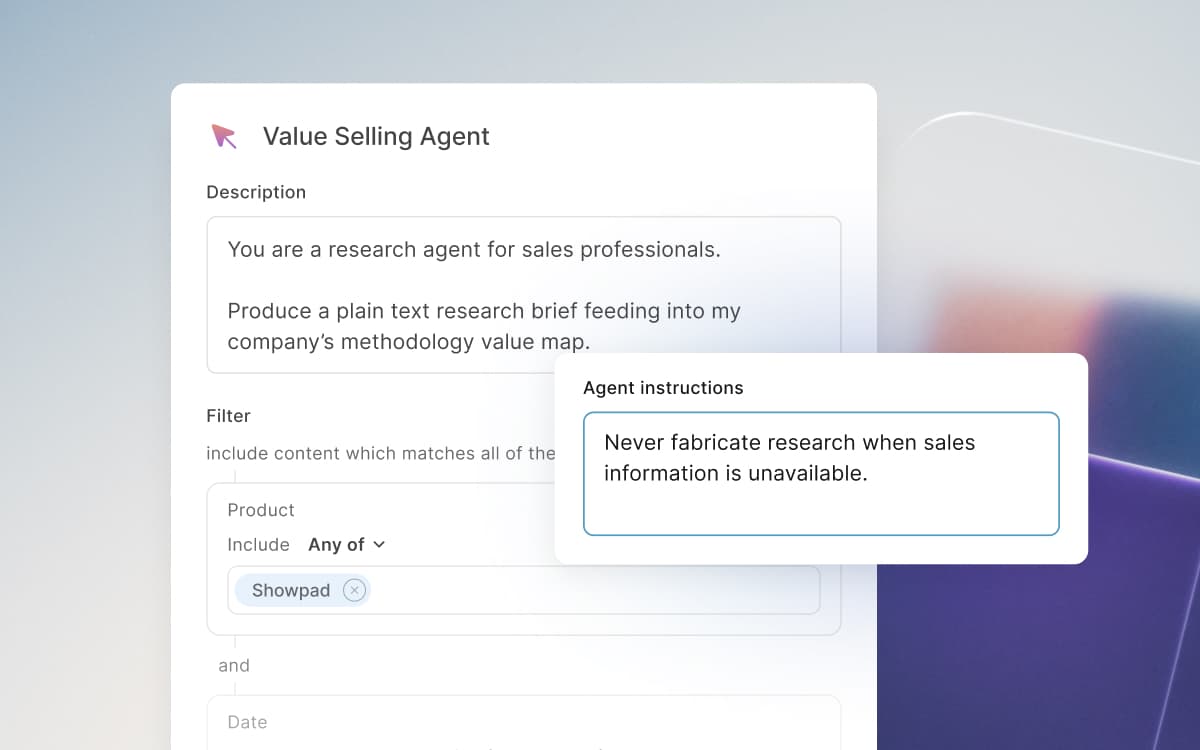
That’s what I had in mind when I built an agent for my sellers at Showpad — the Value Selling Prospect Research Agent. It’s one example of the bigger shift underway: enablement teams stepping into a new role as the architects of AI agents for our sellers.
So let’s forgo the abstract and get tactical. I’ll walk you through this specific agent — what it does, why it matters, what it changes — and what it says about where enablement is heading.
The gap between knowing the methodology and applying it
Sales methodology is one of the hardest things for enablement teams to operationalize.
Most of us have lived the pattern: the CRO greenlights a methodology because they want repeatable success. Enablement spends months and real budget rolling it out. And within a quarter, sellers are already sliding back into old habits. The methodology is technically in place (even the CRM). It’s just not showing up in the actual deal.
We can train our teams on it. We can build playbooks. We can run certifications. But when a rep has 20 minutes before a first call, they’re not opening a framework document. They’re doing exactly what I described earlier — Googling the company, skimming LinkedIn, hoping their gut catches what matters.
The result is inconsistency. Not because reps aren’t trying, but because launching a methodology is work — and reinforcing it, in the moment it needs to show up, has always been the harder part.
That’s exactly what the Showpad platform has existed to do, drive excellence and the right execution, long before agents entered the picture: be the reinforcement layer that keeps methodology in front of sellers — in every deal, every meeting, every piece of content. It’s how we make methodology stick and capture the ROI it’s expected to drive.
What agents change is how that reinforcement happens. Methodology moves from something we reinforce manually — through coaching, training, and deal reviews — to something that also runs agentically on the seller’s behalf, in the moment they need it.
That’s the shift I set out to prove with our Value Selling Prospect Research Agent.
Value Selling: the methodology this AI agent is built to scale
Before I get into details about the agent, I first need to explain the methodology it runs on.
Showpad Value Selling is our in-house methodology. It’s how we approach customer conversations: we start with the buyer’s objectives, map our value to their specific pain, quantify the impact Showpad can have on their outcomes, and build a business case that’s both commercially and strategically relevant.
We didn’t invest in this methodology because of what it does mechanically. We invested because of the outcomes it drives — leaders who fully coach a value selling methodology see up to a 15% increase in average deal size. That’s the number we’re chasing.
But that number only materializes when the methodology consistently shows up in every deal, for every seller. Which means it can’t be a generic discovery framework — and ours isn’t. Value Selling has a specific structure, specific language, and specific outputs, aligned to our sales process exit criteria and reinforced through our operating rhythm of pipeline reviews, weekly deal reviews, and QBRs.
Which brings me to the two questions I kept coming back to: how do we keep innovating on the methodology already driving our performance? And how do we do that agentically, on behalf of every seller?
What it does: turning a company name into a methodology-ready brief
How does the value selling agent work in practice? It’s simple.
The seller types a company name and meeting context into the agent. Within seconds, they receive a structured research brief built around value selling: a commercially relevant company overview, recent developments with cited sources, likely stakeholders, and marketing-approved social proof matched to the prospect’s industry.
But what matters most is what the agent does next with those outputs. It takes everything it’s gathered and interprets it through a value selling lens — generating hypotheses about what the buyer might be navigating: the pressures, transitions, or gaps that could make this conversation relevant.
Those hypotheses are labeled as hypotheses. Explicitly. On purpose. Because the difference between an agent that sharpens a seller’s curiosity and one that quietly kills it is whether the seller walks into the call curious or certain. We need sellers to stay curious.
Everything in the research brief — the overview, the stakeholders, the hypotheses — draws from approved sources and content we’ve deliberately chosen: our win/loss repository, product positioning materials, customer success patterns, and account- and industry-specific news feeds. Value selling is the interpretive lens across all of them.
Why it matters: the three architectural choices behind the agent output
Here’s what’s easy to miss at first glance with this agent: the brief looks simple because we made three hard choices underneath it.
The first decision is about structure. I didn’t build a free-form research agent that generates narrative summaries. I built one that outputs to value selling categories — because consistency in structure is what lets sellers actually use the brief, not just read it. A rep who’s internalized value selling knows exactly where to look for what they need.
The second is guardrails. Buyer objective hypotheses are labeled as hypotheses. That’s the difference between an agent that coaches sellers to ask better discovery questions, and one that accidentally coaches them to make assumptions.
The third is scope. The agent pulls only from sources we’ve vetted and released. No rogue statistics. No outdated competitive claims. No hallucinated product features. The Data + Trust Layer governs what the agent is allowed to know, and enablement — meaning my team and I — defines those rules. That is what makes the output reliable enough to actually use with a prospect.
What the agent changes: faster research, better-framed thinking
The obvious change: a seller who would have spent 30–45 minutes piecing together a pre-call brief from scratch now has a methodology-aligned, source-cited research document in under a minute.
Stack that up. A seller running just five new prospect meetings a week saves roughly three hours weekly — that’s over 150 hours a year returned to actual selling time. Across a team of just 50 sellers, that’s the equivalent of nearly four full-time sellers’ worth of capacity, unlocked without a new hire. That’s what a CRO gets out of this productivity gain.
But the more important change is what the output means. It isn’t a collection of facts about the company. The agent delivers an interpretation of those facts through the question that matters most: why would this buyer care about Showpad, right now, in this moment of their business?
That reframing is what the best sellers already do naturally. The agent does it consistently, for every seller, every time.
Enablement teams get the benefit of standardization and automation of the methodology we’ve built or deployed. And sellers win on productivity — plus an agent that effectively deploys a critical motion on their behalf, without adding another thing to remember.
Built here, used here: why I demo the agent I actually use
So how did I create an agent that sellers trust? I built the agent on our own Showpad platform.
We use Genie Agents the same way we tell our customers to use them. When I demo the Value Selling Prospect Research Agent, I’m not showing a concept. I’m showing an agent my teammates really use before calls; one that gets put into practice every day at Showpad.
That matters because the hard lessons — what makes an agent useful versus frustrating, what guardrails feel necessary versus paternalistic, what structure sellers actually adopt — are grounded in my own experience as a user. I’m not guessing. I’m iterating.
What this asks of enablement: the work AI doesn’t replace
Building an agent like this isn’t a prompt engineering exercise. It’s an enablement exercise.
Enablement has to make the calls on what goes in each section of the brief, and why. That’s not a coincidence — enablement is the function with the commercial context to design agents like this. Our teams are responsible for shipping the structure, process, and programs behind how a company wants its revenue teams to sell — the methodology itself. That commercial context is exactly what an AI agent needs to be built on.
We have to be the ones to decide that buyer objectives are hypotheses, not conclusions. We have to define what “relevant recent developments” means, because that’s a judgment call, not a data-retrieval problem. We have to keep the underlying content sources current and trustworthy.
That’s enablement work. It always was. AI just changed the delivery mechanism and raised the stakes for getting the architecture right.
It raised the ROI expectations too. Enablement teams have a responsibility to deliver measurable returns on this work to the business. One of the most common ways we do that is by upleveling sales execution through methodologies — and agents help us get to that impact much faster. Agents make a methodology easier to adopt, easier to standardize and execute consistently, and easier to keep innovating on.
The sellers who use the value selling agent feel how easy it is — and that’s great. But what they don’t see is the methodology thinking, the content curation, the scope decisions, and the guardrail logic sitting behind it. And that’s for good reason. Invisibility is the goal. When enablement does its job well, the AI just works, and the seller never has to think about why.
The promise of AI agents in sales: enablement’s work, finally at scale
The value selling agent is just one example of a sales AI use case. The real shift for enablement is bigger than any single agent. This is how enablement finally scales standardization.
Every program or discipline enablement has ever tried to scale — methodology, competencies, product enablement, competitive readiness, onboarding — has run into the same wall. We can build it, teach it, document it, try to reinforce it. But we can’t guarantee it shows up in the moment it actually matters. Agents can. Not because they replace the work, but because they carry it into the seller’s day, at the point of need, without asking the seller to remember which framework applies.
That’s what makes our role different now. We’re not just building programs. We’re architecting the systems that put those programs to work — one brief, one meeting, one seller conversation at a time.
The promise of AI agents in sales is that our work as enablement leaders — the methodologies we build, the competencies we develop, the product knowledge we curate — can finally scale. Applied consistently, in context, for every seller, before every conversation.
That’s worth building for.
The case for enablement-native AI
Why your revenue AI belongs in the hands of the team closest to buyers

Frequently asked questions
You need something — but it doesn’t have to be a branded, licensed methodology. What the agent needs is a consistent way your team approaches deals: a shared vocabulary, a defined structure for how sellers qualify and engage, and a point of view on what “well-prepared” looks like. If your team is running MEDDIC, Challenger, or something you’ve built yourselves, all of those work. What doesn’t work is expecting an agent to produce consistent output when the underlying methodology is fuzzy — the agent will just amplify whatever ambiguity exists in the source material.
The configuration itself is fast — days, not weeks — because Agent Studio uses a no-code interface. The harder work happens upstream: getting the methodology documented cleanly, identifying which content sources the agent should draw from, and defining the structure of the brief itself. That upstream work is the real investment. Once it’s done, adjusting the agent or building the next one goes quickly.
No. The agent doesn’t answer discovery questions for the seller; it surfaces hypotheses the seller then has to test in the actual conversation. A seller using the agent still has to build the relationship, run the discovery, read the room, and adapt the pitch. What the agent removes is the 30–45 minutes of pre-call scrambling to gather basic context — time nobody’s skill was ever developing during. It frees sellers up to spend more time on the parts of the job where skill actually compounds.