








Learning content is one of the most important tools an enablement team produces. It’s how you transfer product knowledge, reinforce selling skills, and keep a global workforce aligned on what matters. But the process of creating that content — recording narration, translating for international teams, ensuring accessibility — has never matched the urgency of the need.
Learning authors know this better than anyone. You need to produce high-quality training at speed, often for teams spread across multiple languages, time zones, and regulatory environments. And you’re doing it with limited resources, inconsistent access to subject matter experts, and a production process that still relies on booking quiet rooms and hoping the audio sounds the same from one session to the next.
Authoring AI was built to close that gap. To eliminate manual work in the content creation process — with significant benefits for international enterprises that need to deliver organizational knowledge at scale.
Consistent narration without the recording burden
Anyone who has recorded voiceovers for training content understands the hidden cost. You need a decent microphone, a controlled environment, and enough uninterrupted time to get it right. If you can’t finish in a single session, you risk inconsistent audio — different room tone, different vocal quality — that creates a disjointed experience for the learner.
Authoring AI’s text-to-speech narration removes that constraint entirely. Select a voice from the voice library, and the platform auto-generates narration from your slide notes in seconds. The result is consistent, high-quality audio with realistic, human-sounding AI voices — produced in a fraction of the time manual recording requires.
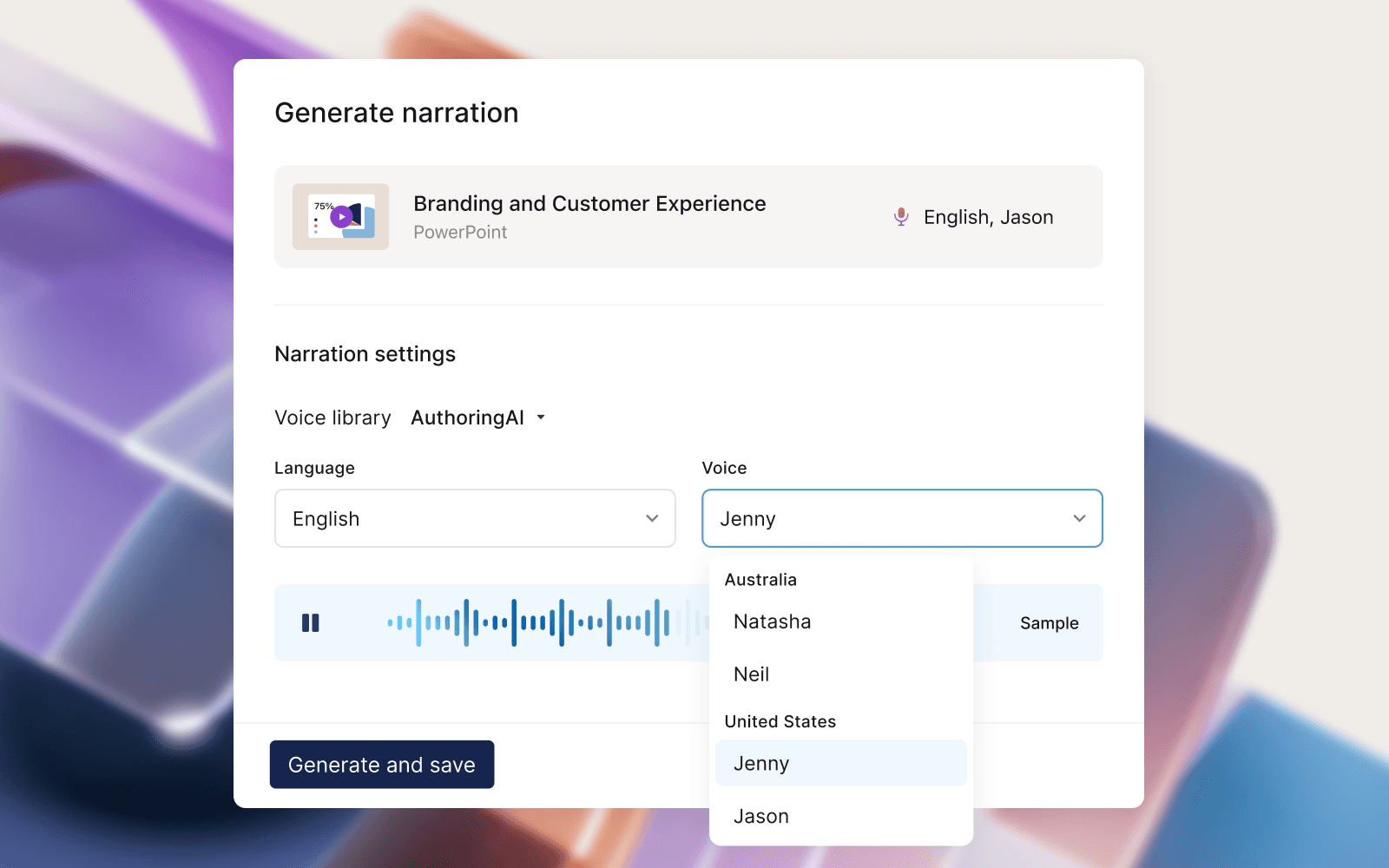
Reliance Matrix used Authoring AI to cut enrollment presentation authoring time from four hours to one. That’s not an incremental improvement. It’s a fundamentally different operating model for enablement teams under pressure.
Accessibility that’s built in, not bolted on
Authoring AI works in both directions: text-to-speech and speech-to-text.
Auto-generated captions
- A recent survey by Preply found that 50% of Americans watch content with subtitles most of the time.
- Whether your team members are deaf or hard of hearing, working in a noisy environment, or simply prefer to read along, captions have become essential.
- Auto-captioning your training content ensures people can consume it without audio and helps you meet accessibility compliance requirements for inclusive teams.
Auto-generated slide notes
- For presentations that have audio but no written script, Authoring AI produces slide notes from the existing recording.
- This preserves institutional knowledge that would otherwise be locked inside a video file — and makes that content searchable within Showpad.
- When someone asks Genie Assistant about a topic, training videos surface alongside sales and marketing collateral for a complete view of internal knowledge.
This also solves a practical problem every enablement team eventually faces: the original narrator is no longer available. Create slide notes from existing audio, then regenerate narration in a new voice. Edits and updates no longer require re-recording from scratch.
Workflows that solve real problems
Individually, text-to-speech and speech-to-text are useful capabilities. Together, they create workflows that address common operational challenges:
Speech-to-text to text-to-speech: Prompt a script from existing audio for presentations that never had notes. Then produce new narration from that script in a consistent voice. This solves the “lost narrator” problem and maintains quality even as team members change.
Text-to-speech to speech-to-text: Develop narration from slide notes, then use that audio to auto-create captions.
Full translation workflows: Use speech-to-text on content without a written script. Translate that text into another language. Construct narration in a native-sounding AI voice for the new language. Then create captions from that narration. One piece of content, fully localized, without an outsourced vendor.
Enterprise scale without the enterprise price tag
Translating training content for international teams has traditionally been expensive and slow. Outsourced translation for a single five-minute presentation with ten slides can cost upwards of $1,800 — and take weeks to deliver.
Authoring AI compresses that timeline to minutes. Choose a language from the voice library, translate the notes, adjust as needed, and generate audio in a realistic, native-sounding AI voice. Whether you’re enabling teams in Shanghai, Mexico City, Paris, or Sydney, the process is the same — and the output is consistent.
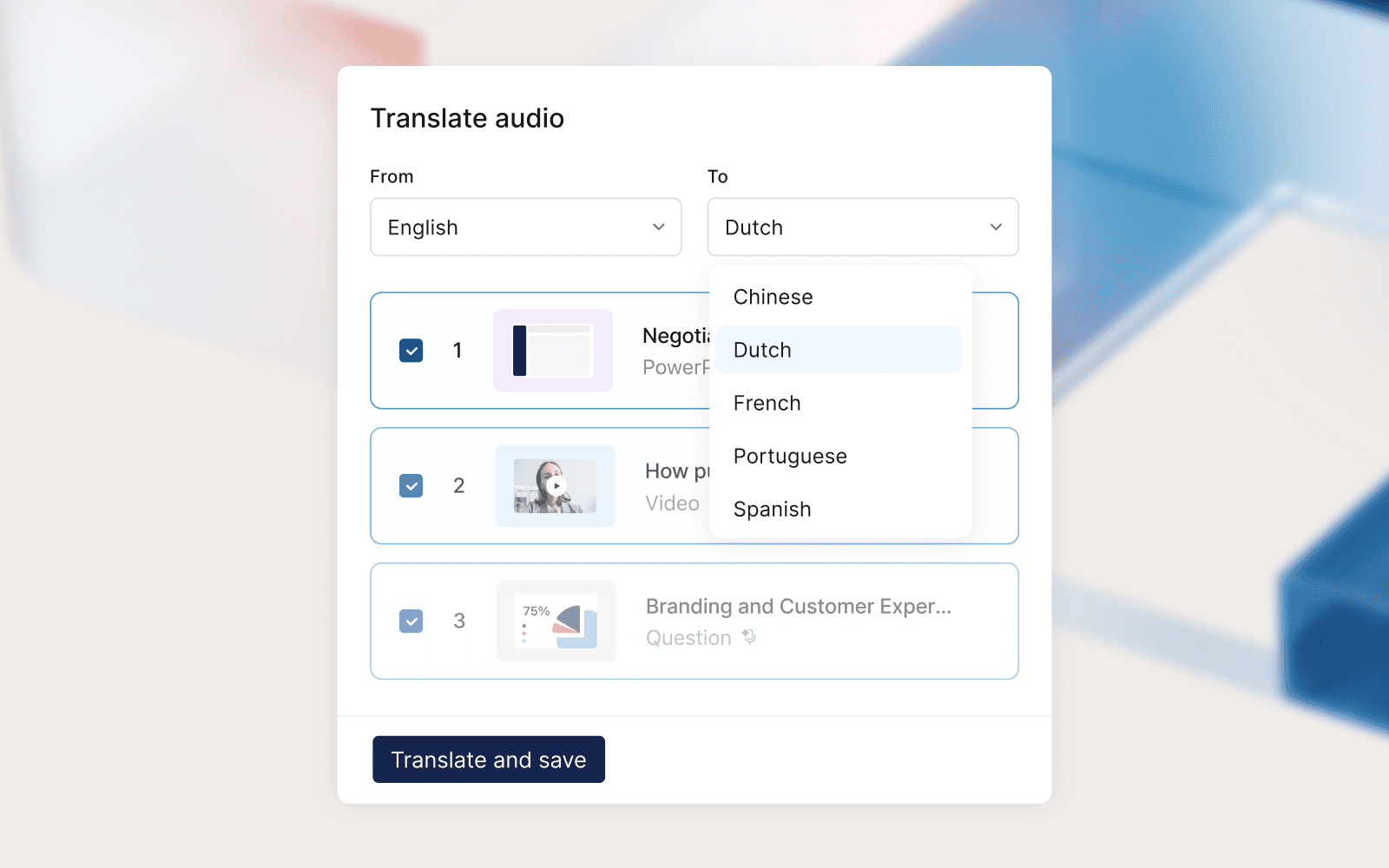
This matters for organizations where product knowledge changes frequently and the cost of delayed training is measured in lost deals, compliance risk, or inconsistent customer experiences across regions.
Your voice, without your time
Authoring AI includes voice cloning from a single recording. The platform captures your tone and timbre, then provides new narration in your voice for any content you create — including words you never recorded.
Learning authors and subject matter experts can maintain a personal connection with their teams without having to record every piece of content.
What Authoring AI means for enablement and marketing teams
Showpad customers don’t have the luxury of slow content cycles. Their products change. Their markets shift. Their global teams need to be ready — not next quarter, but now.
Authoring AI gives enablement and marketing teams the tools to produce polished, multilingual, accessible content at a speed and scale that wasn’t possible before.
Success stories from the field
Hear how the Fabletics team scaled global learning with Authoring AI.

Frequently asked questions
Authoring AI is a capability within the Showpad platform that uses AI to accelerate the creation of training and learning content. It includes text-to-speech narration with realistic AI-generated voices, speech-to-text for auto-generating captions and slide notes, voice cloning, and built-in translation. It’s designed for enablement and marketing teams who need to produce high-quality, multilingual training materials.
Authoring AI lets you translate slide notes into multiple languages and create narration in a native-sounding AI voice for each one. You can also auto-generate captions in the translated language. The entire workflow — from original content to fully localized training — happens within the platform. Your teams in every region receive the same quality training, in their language, on your timeline.
Yes. Authoring AI includes voice cloning that requires only a single recording. From that sample, the platform produces new narration in your tone and timbre for any content you create. This allows you to maintain a consistent, personal feel across training materials without recording every piece of audio yourself — particularly useful when making edits or updates to existing content.